
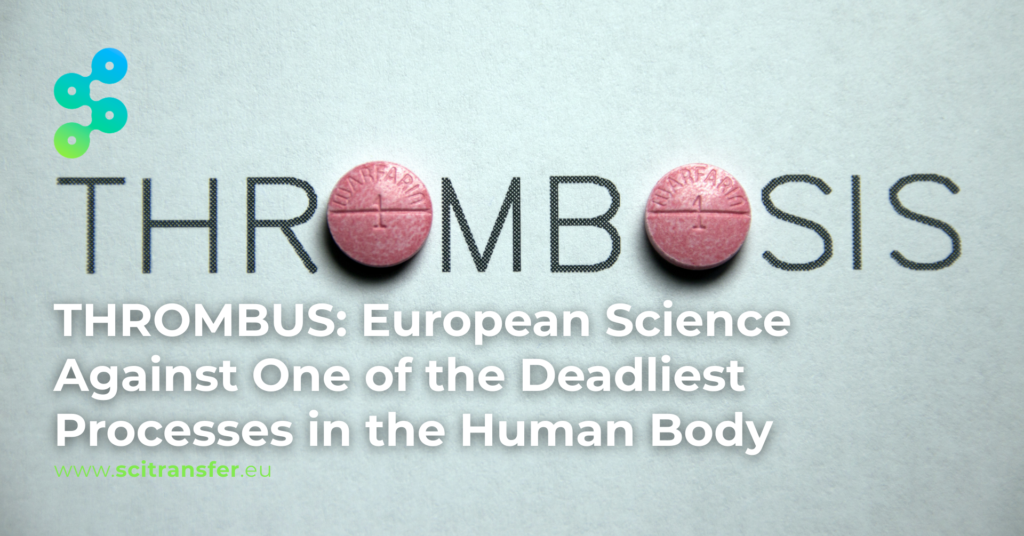
There is a process in the human body without which we could not survive even the smallest injury – blood clotting. That very same process, however, when it escapes control, can turn into one of the most dangerous threats to life. Thrombosis – the formation of a pathological blood clot – lies at the heart of heart attacks, strokes, and pulmonary embolisms. These are conditions that claim millions of lives each year and leave millions of others with permanent disabilities.
It is against this large-scale medical challenge that the European project THROMBUS (Project ID: 101137227) is directed – an international scientific initiative funded by the European Union, with the ambition to deepen understanding of the develop a wearable point-of-care system for continuous monitoring and early detection of deep vein thrombosis, integrating AI-driven detection and multimodal sensing.
THROMBUS is not an isolated study, but part of a broader European strategy for translational medicine – science that connects the laboratory with the clinic and places the patient at the centre of research efforts.
When a Clot Becomes a Threat
Thrombosis is a paradox of biology. The mechanism that protects us from blood loss can block an artery or a vein and lead to catastrophic consequences. In this sense, it is not a single disease but a complex pathological process underlying a range of clinical conditions.
The THROMBUS project seeks to clarify in greater detail what exactly happens at the moment when physiological clotting becomes pathological. The researchers are working towards a better understanding of the interactions between platelets, coagulation factors, the vascular wall, and inflammatory processes. Such an integrative approach is essential, because thrombosis is not merely a “mechanical blockage” but a dynamic biological process involving multiple systems.
This deeper understanding is the first step towards more precise diagnostic tools and more effective therapies.
From Fundamental Knowledge to Clinical Change
The strength of THROMBUS lies in its translational character. The project combines fundamental research with clinical data, building a bridge between laboratory discoveries and real medical practice. This model of work is among the strategic priorities of European research and innovation programmes.
In practical terms, this means striving for earlier identification of patients at increased risk of thrombosis and for more precise management of therapy. At present, treatment often balances between two dangers – the risk of a new clot and the risk of serious bleeding as a result of anticoagulant therapy. A better understanding of individual differences in thrombotic risk may lead to more personalised solutions and greater safety for patients.
In this way, the project has the potential not merely to add new publications to the scientific literature, but to change the way thrombotic risk is assessed and managed.
The Significance for Society
Although deeply scientific in nature, THROMBUS has a clearly defined societal dimension. Thrombotic complications are among the leading causes of death and disability in Europe. Every prevented stroke or heart attack means not only a saved human life, but also enormous social and economic resources preserved.
Investment in projects of this kind is an investment in the sustainability of healthcare systems. The costs of emergency care, intensive treatment, and long-term rehabilitation following major thrombotic events are substantial. If the scientific results lead to more effective prevention and more accurate therapy, the impact will be multidimensional – medical, social, and economic.
In addition, the project contributes to the strengthening of Europe’s scientific network. The international consortium brings together experts from different institutions and countries, creating a sustainable platform for future joint research and innovation.
Who Stands Behind THROMBUS
THROMBUS is implemented by a European consortium of academic and clinical institutions united around the shared goal of improving the understanding and management of thrombotic diseases. The project is funded by the European Union within the framework of a research and innovation programme.
Detailed information about the project’s objectives, partners, and activities is publicly available through the official channels of the European Commission and the project itself.
This transparency is an important element of the European funding model – society has access to information about how public funds are used and what objectives are pursued.
The Cost of Fighting Thrombosis
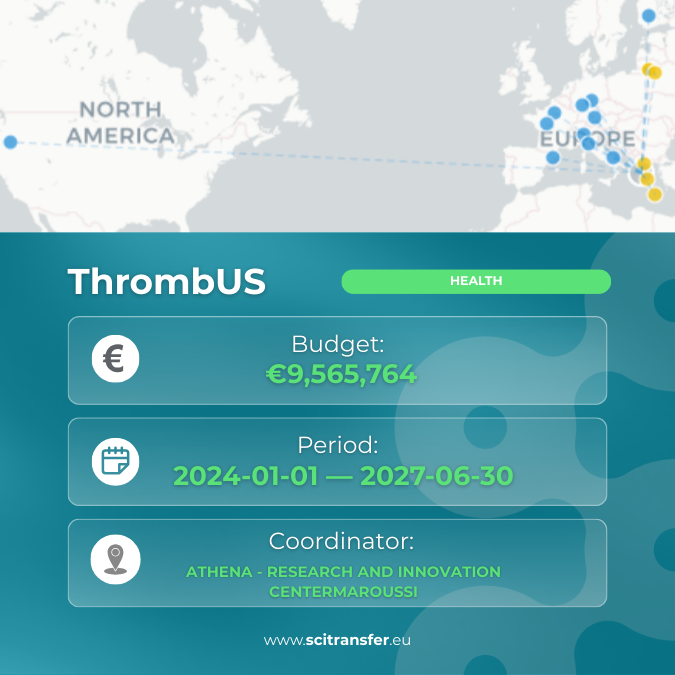
The THROMBUS project (ID: 101137227) is funded with several million euros from the European Union (Total cost €9,565,763.75; EU contribution €8,141,251.25). This budget covers the scientific research, coordination of the consortium, data management, as well as communication and dissemination activities.
At first glance, the amount may appear significant. In the context of the burden of thrombotic diseases, however, it represents a strategic investment. The costs of treatment and social care for severe cardiovascular incidents are many times higher. If the project contributes even partially to better prevention or therapy, the societal return will be substantial.
Innovation Potential and Future Commercialisation
Beyond its scientific and clinical ambitions, THROMBUS carries a clear innovation dimension with tangible market potential. Thrombotic diseases remain a major burden for healthcare systems across Europe, creating a strong demand for earlier detection tools, improved risk stratification methods, and more precise monitoring solutions. Projects funded under Horizon Europe are explicitly encouraged not only to generate knowledge, but also to translate results into exploitable outcomes with societal and economic value.
Within this framework, THROMBUS positions itself at the interface between biomedical research and applied health innovation. The development of novel diagnostic approaches, data-driven risk models, or advanced monitoring technologies creates opportunities for future intellectual property generation, clinical validation pathways, and potential integration into medical devices or digital health ecosystems.
European policy on knowledge valorisation emphasises the strategic management of intellectual assets, licensing opportunities, spin-offs, and structured pathways to market uptake. By embedding exploitation planning into the project lifecycle, THROMBUS aligns with the EU’s objective to reduce the “valley of death” between research results and real-world application. If successful, its outputs could evolve into scalable solutions adopted by hospitals, diagnostic laboratories, or digital health providers across Europe.
In this sense, the project’s impact is not limited to publications or clinical insights. Its long-term value may also lie in strengthening Europe’s capacity to convert biomedical excellence into innovation, competitiveness, and sustainable health technologies.
Science as Long-Term Protection
THROMBUS is an example of how European science policy directs resources towards diseases of major societal importance. It combines fundamental knowledge, clinical practice, and international cooperation in an effort to answer a question with direct consequences for millions of lives: why and when does a blood clot become a threat – and how can we prevent it?
In a world where medical challenges are becoming increasingly complex, projects of this kind demonstrate that coordinated European science remains one of the most powerful instruments for protecting public health.
Autor: Radoslav Todorov
Sources
- https://thrombus.eu/
- https://cordis.europa.eu/project/id/101137227
- https://map.scitransfer.eu/project/thrombus-101137227
- https://www.linkedin.com/company/thrombus-eu-project/
- https://research-and-innovation.ec.europa.eu/strategy/dissemination-and-exploitation-research-results_en
- https://research-and-innovation.ec.europa.eu/research-area/industrial-research-and-innovation/eu-valorisation-policy_en
Map. Scitransfer.EU (https://map.scitransfer.eu/project/thrombus-101137227)