
Across Europe’s factories, transport networks, and buildings, a quiet transformation is underway. Wireless sensors—small, often unnoticed devices—form the backbone of modern digital infrastructure, enabling asset tracking, condition monitoring, and smarter operations. Yet one persistent limitation has constrained their full potential: battery life.
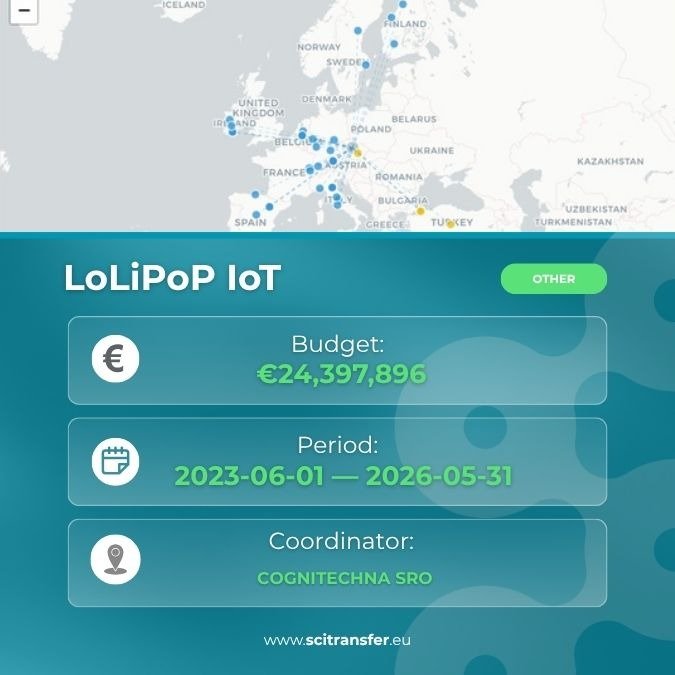
The Horizon Europe project LoLiPoP IoT (Long Life Power Platforms for Internet of Things) addresses this challenge directly. With approximately €7.7 million in EU funding and a total project budget of €24.4 million, the initiative aims to transform how IoT systems are powered, maintained, and scaled.
At its core, LoLiPoP IoT goes beyond improving batteries—it redefines how connected devices use and manage energy.
From 18 Months to 5+ Years: A Step Change in IoT
Today, many wireless IoT sensors operate for around 18 months before requiring battery replacement. In large-scale deployments, such as industrial facilities or transport systems, this results in significant maintenance costs, operational disruption, and resource demands.
LoLiPoP IoT introduces a new approach: extending sensor battery life to more than five years.
This is achieved through the integration of multiple advanced technologies, including multi-source energy harvesting (from vibrations and light), ultra-low-power electronics, and embedded artificial intelligence (AI). Together, these innovations reduce energy consumption while supplementing it with ambient energy sources.
Rather than passively consuming power, LoLiPoP IoT devices dynamically adapt to their environment. Embedded AI enables sensors to adjust their behaviour based on available energy, ensuring efficient and reliable operation. The result is a new generation of intelligent, energy-aware devices.
Practical Impact Across Key Sectors
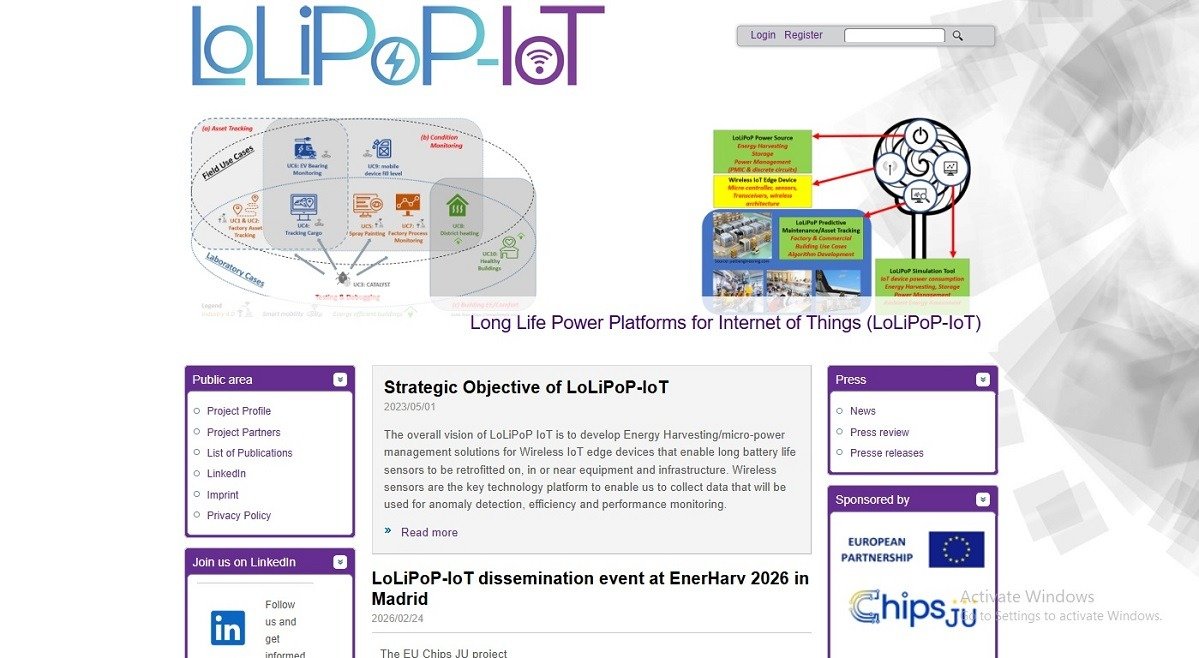
A defining feature of LoLiPoP IoT is its strong focus on real-world applications. The project is being validated through 12 laboratory and field use cases across three key domains: industry, smart mobility, and energy-efficient buildings.
In industrial settings, the technology supports asset tracking and condition monitoring—core elements of Industry 4.0. By enabling predictive maintenance, sensors can identify issues before failures occur, reducing downtime and improving productivity.
In transport and logistics, enhanced tracking and data collection improve the flow of goods and assets. The project is expected to achieve reductions of over 10% in production time, cycle time, and inventory costs by enabling better identification of bottlenecks and more efficient workflows.
In buildings, LoLiPoP IoT contributes to both energy efficiency and occupant well-being. Long-life sensors enable smarter control of heating, lighting, and ventilation systems, delivering energy consumption reductions of more than 20% while improving comfort.
Economic and Operational Benefits
The project’s impact extends beyond technical performance. By reducing the need for battery replacement, LoLiPoP IoT significantly lowers maintenance demands, reducing overhead costs from over 30% to below 15% for both mobile and fixed assets.
The financial implications are substantial. Improved asset tracking alone can deliver savings of hundreds of thousands of euros per year, depending on the use case. In parallel, the project is expected to generate annual revenues exceeding €10 million for industry partners offering asset tracking and condition monitoring services.
Together, these outcomes demonstrate a broader shift: IoT systems are becoming not only more capable, but also more economically sustainable.
Building an Ecosystem for Scalable Innovation
LoLiPoP IoT brings together a diverse ecosystem of technology developers, system integrators, and end users. This collaborative approach ensures that solutions are practical, scalable, and aligned with real market needs.
A key objective is to enable the retrofitting of existing wireless sensor networks, allowing organisations to upgrade current systems without costly replacements. This focus on compatibility reflects a pragmatic approach to innovation—one that prioritises integration with existing infrastructure.
The project also develops advanced simulation models to optimise component design and system integration, alongside energy-efficient wireless communication architectures.
Advancing IoT Through Technology Integration
Scientifically, LoLiPoP IoT represents the convergence of several disciplines, including energy harvesting, electronics, wireless communication, and embedded AI/ML.
This integration is critical. While each technology offers benefits individually, their combined application enables significant improvements in latency, robustness, and power efficiency. By embedding intelligence directly at device level, the project also contributes to the advancement of edge computing, reducing reliance on centralised data processing.
A Scalable and Sustainable Vision for IoT
Running from June 2023 to May 2026, LoLiPoP IoT addresses a critical need in Europe’s digital transformation: scalable, low-maintenance IoT systems.
By extending battery life, reducing operational costs, and enabling intelligent energy use, the project tackles one of the key barriers to large-scale IoT adoption. Its results have the potential to reshape how connected systems are designed and deployed—benefiting industry, public infrastructure, and citizens alike.
In an increasingly connected world, the success of IoT depends not only on what devices can do, but on how efficiently—and how long—they can do it. LoLiPoP IoT provides a practical pathway towards that future.
Autor: Radoslav Todorov
Images: canva.com, scitransfer.eu, lolipop-iot.eu
Sources: