
A new ERC-funded project based in Spain is taking on one of the deepest open questions in modern exoplanet science: are sub-Neptunes balls of gas, worlds of water, or both?
For decades, astronomers searched the cosmos for planets like our own. What they found instead, again and again, was something stranger: worlds slightly larger than Earth and noticeably smaller than Neptune, orbiting their stars on tight, rapid orbits. These so-called sub-Neptunes are the most abundant type of planet in the Milky Way, particularly around Sun-like stars. They have no analogue in our own Solar System — and despite a decade of effort, scientists still cannot agree on what they are made of.
A new five-year project based in Spain intends to settle the argument. Its name is THIRSTEE — Tracking Hydrates In Refined Sub-Neptunes to Tackle their Emergence and Evolution — and it carries one of the European Research Council’s flagship Starting Grants for 2024.
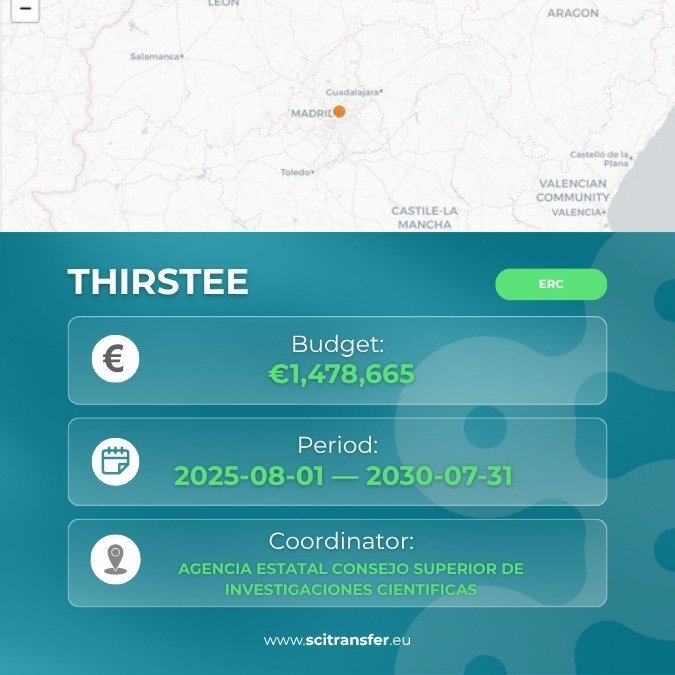
AT A GLANCE Project: THIRSTEE — Tracking Hydrates In Refined Sub-Neptunes to Tackle their Emergence and Evolution Funder: European Research Council (Horizon Europe, ERC-2024-STG) Budget: €1,478,665, fully covered by the EU contribution Duration: 1 August 2025 – 31 July 2030 (60 months) Host: Spanish National Research Council (CSIC), based at the Instituto de Astrofísica de Andalucía, Granada Status: Signed and active (9 of 60 months elapsed)
A planet without an Earthly twin
Sub-Neptunes sit in a curious gap. Their masses and radii fall between those of Earth and Neptune, yet their internal structure remains contested. Two competing pictures dominate the literature.
In the first, sub-Neptunes are gas dwarfs: rocky cores roughly the size of Earth, enveloped in thick hydrogen-rich atmospheres, all of it assembled close to the parent star where the planet is observed today. In the second, they are water worlds: planets born far beyond the snow line, made up of roughly equal parts ice and rock, that later migrated inward.
The distinction matters. A gas dwarf is a hostile, hydrogen-blanketed object with no obvious astrobiological promise. A water world, by contrast, could in principle harbour deep liquid oceans beneath its atmosphere — a prospect that, if confirmed, would reshape the search for life beyond the Solar System.
The trouble is that the data we currently have can be made to fit either picture. The same measured mass and radius can be reproduced by very different mixtures of rock, ice and gas. THIRSTEE’s project description puts it bluntly: the field has been held back by a persistent modelling degeneracy, and previous studies — for all their ingenuity — have not been able to break it.
Three techniques, one framework
THIRSTEE’s strategy is to refuse the choice between methods and instead combine them. Three families of observation are usually applied to small exoplanets in isolation:
- Transit photometry measures how much a planet dims its star’s light when it passes in front, yielding the planet’s radius.
- Radial velocity spectroscopy measures the gravitational tug the planet exerts on its star, yielding its mass.
- Atmospheric characterisation, increasingly possible with the latest space telescopes, probes the chemistry of whatever envelope the planet has retained.
On their own, each technique leaves crucial ambiguities. Together, the project argues, they can be made to converge. THIRSTEE will fold all three into a single statistical framework — and, crucially, that framework will explicitly account for the observational biases that have long distorted exoplanet samples. Small, cool, distant planets are systematically harder to detect than hot, large ones; failing to correct for that contaminates any conclusion drawn about the population as a whole.
By correcting for those biases and pushing into corners of parameter space that earlier surveys neglected, the project intends to produce something rare in this field: a sample of sub-Neptunes that can be compared, like for like, with synthetic populations from planet-formation models. If gas dwarfs and water worlds coexist, THIRSTEE expects to be able to tell them apart and to quantify how their proportions vary with the type of host star.
What is at stake
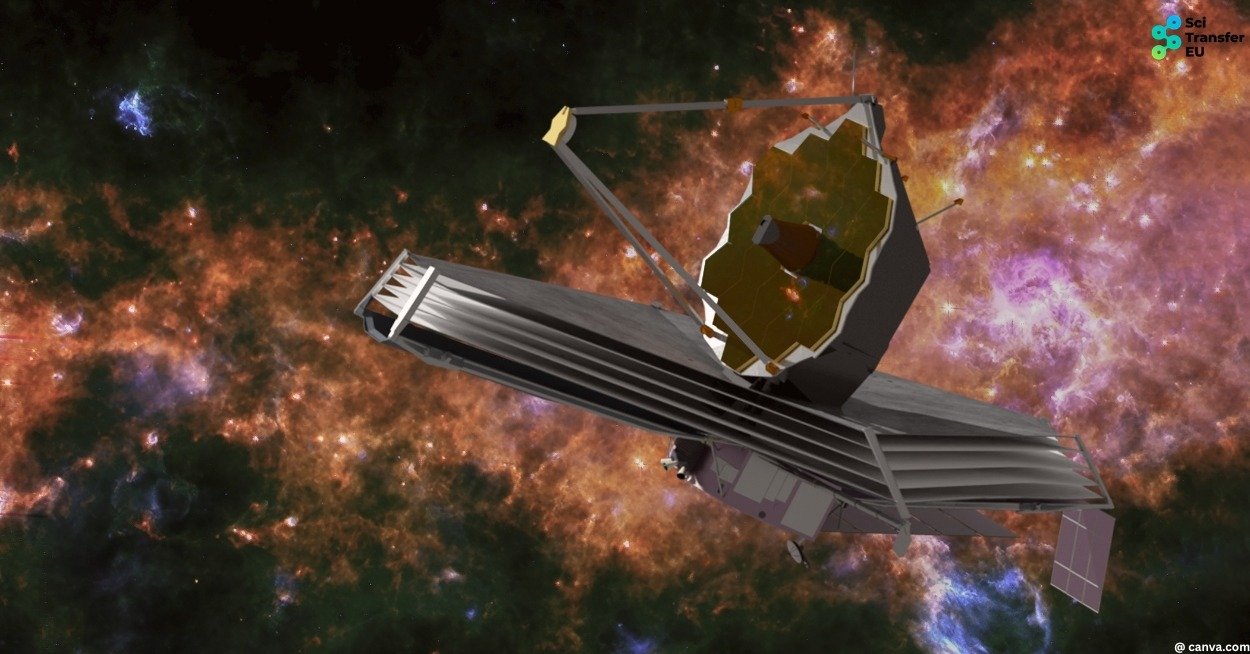
The scientific stakes are unusually concrete. If sub-Neptunes are predominantly gas dwarfs, the most common planets in the galaxy are essentially uninhabitable, and the search for life narrows. If a substantial fraction are water worlds, the inventory of potentially habitable environments in the Milky Way grows dramatically — and a generation of atmospheric observations with facilities such as the James Webb Space Telescope and the upcoming Ariel mission will need to be re-interpreted in that light.
There is also a simpler, civic argument. Sub-Neptunes are the planets we discover most often. A European-led answer to what they actually are would be a substantive return on the public investment that has built the continent’s exoplanet infrastructure over the past twenty years.
The question is not academic in another sense, either. Each new generation of telescopes — ground-based spectrographs, JWST already in orbit, and Ariel scheduled to launch in 2029, within THIRSTEE’s own lifetime — will spend a meaningful share of its observing time pointed at exactly these planets. Without a robust framework for interpreting what they see, that observing time risks being misread. THIRSTEE’s ambition is to provide that framework before the data deluge arrives, not after.
The team and the budget
THIRSTEE is hosted by the Spanish National Research Council (CSIC), with the project based at the Instituto de Astrofísica de Andalucía in Granada. It is a single-beneficiary grant, run by one principal investigator and a small dedicated team rather than a sprawling consortium — a structure typical of ERC Starting Grants, which are awarded to early-career researchers to build their first independent group. The project formally began on 1 August 2025 and runs until 31 July 2030, a sixty-month window of which nine months have now elapsed.
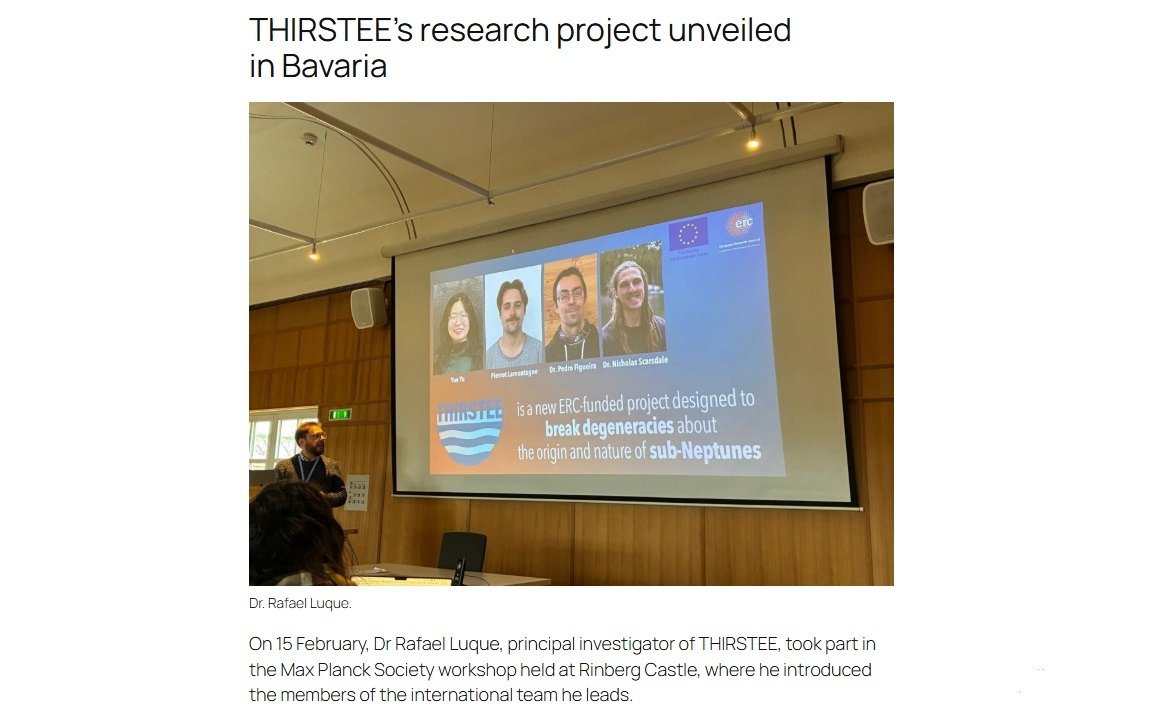
The grant is worth €1,478,665, funded in full by the European Commission under the Horizon Europe programme (call ERC-2024-STG). That figure is somewhat below the average ERC Starting Grant in this round — roughly €1.9 million — placing THIRSTEE among the more cost-efficient projects in its cohort. The budget covers personnel, observing time, atmospheric modelling, and travel for the duration of the project. Recruitment is already under way: postdoctoral and PhD positions associated with the project have been advertised through the Spanish Astronomical Society’s job board, and the project’s news pages document early collaborations — including work led by Dr Rafael Luque with international colleagues — that feed directly into the THIRSTEE programme.
What success will look like
By 2030, THIRSTEE aims to deliver something the field has lacked: a unified, bias-corrected catalogue of sub-Neptunes characterised across mass, radius and atmosphere, paired with a statistical framework rigorous enough to test formation theories head-on. The questions on the project’s own list are unmistakably ambitious:
- Are sub-Neptunes gas dwarfs, water worlds, or a mixture of the two?
- How do their properties depend on the star they orbit?
- Could any of them hide a liquid-water ocean beneath their atmosphere?
These are exactly the questions that taxpayers, students and seasoned astronomers all want answered. Whatever the result, it will carry weight well beyond the specialist literature. The most common planets in the galaxy are about to be examined more carefully than ever before, by a European team operating on a deliberately modest budget. For a continent that has spent two decades building the instruments that made this question possible, THIRSTEE is a fitting next step: a focused, evidence-led attempt to find out what most of the universe’s planets are actually made of.
Follow the project
Readers who want to follow the science as it unfolds can do so directly. The project maintains a public-facing site at thirstee.iaa.es, where team news, scientific milestones, collaborations and outreach material are posted as the work progresses. Open positions for postdoctoral researchers and PhD candidates are listed and updated through the Spanish Astronomical Society, giving students and early-career researchers across Europe a route into the project on its way to its 2030 conclusion. The official ERC funding record can be consulted via the European Commission’s CORDIS portal.
For a question this old and this widely shared — what are the most common planets in the galaxy made of? — that openness is itself part of the answer.
Sources: official project description and ERC funding record (HORIZON-ERC, ERC-2024-STG); thirstee.iaa.es; sea-astronomia.es. Coordinator: Agencia Estatal Consejo Superior de Investigaciones Científicas (CSIC), Madrid, Spain.
Images: canva.com, thirstee.iaa.es
Autor: Radoslav Todorov