
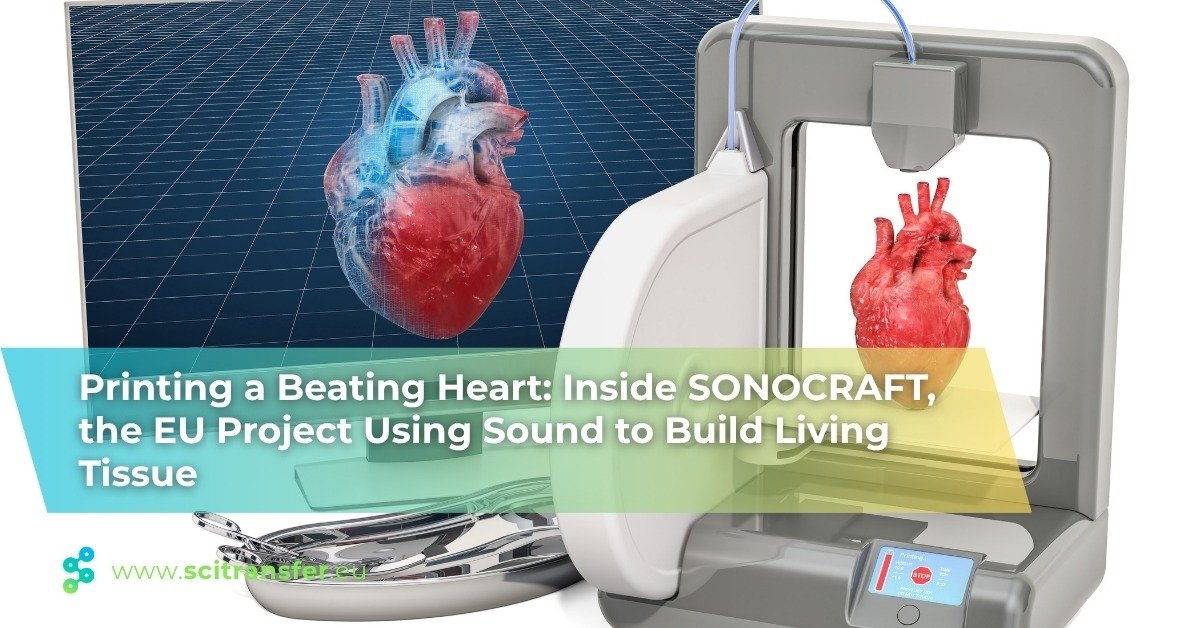
A nine-partner European consortium, coordinated by the University of Barcelona and backed with €3 million from the European Innovation Council, is betting that ultrasound can do what conventional bioprinters cannot: rapidly assemble realistic, centimetre-scale heart tissue in the laboratory.
Project Update · April 2026
Cardiovascular disease still kills more people than anything else on the planet. Behind that statistic lies a quieter, more technical problem: when researchers want to study a failing heart, or test whether a new drug helps it, they rarely have access to anything that genuinely behaves like human heart tissue.
The cells grown in dishes are too flat. The spheroids and organoids floating in incubators are too simple. The animal models are often misleading. A new European project, SONOCRAFT, wants to change that — by using sound waves to sculpt living cells inside a transparent gel, in minutes rather than hours.
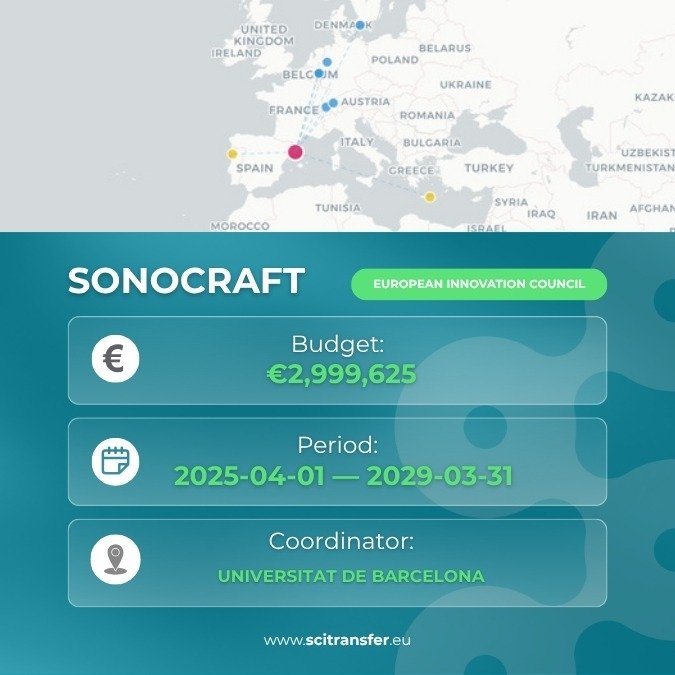
Officially titled High-throughput ultrasound-based volumetric 3D printing for tissue engineering, the project began on 1 April 2025 and will run for four years, until March 2029. It is funded under the European Innovation Council’s Pathfinder Open scheme with a contribution of €2,999,625, covering the entire budget.
Why ultrasound bioprinting, and why now
3D bioprinting is not new. What is new is the recognition that the field has hit a wall.
Conventional bioprinters extrude cells layer by layer through a fine nozzle. The approach is precise but painfully slow, and the very act of forcing cells through a nozzle can damage them. Newer “volumetric” printers can solidify an entire object at once by projecting patterned light into a vat of light-sensitive gel, completing prints in seconds rather than hours. They are fast, but they cannot easily place individual cells in the small, nested patterns that real heart tissue demands.
SONOCRAFT’s answer is to combine the two. The team is building a flagship instrument — SonoPrint — that uses volumetric printing for speed and ultrasonic standing waves for placement. Acoustic fields gently push cells into ordered patterns inside a hydrogel before the gel is set with light. Sound, the consortium argues, is uniquely well-suited to the task: it is cheap, biocompatible, label-free (the cells require no chemical tags), and works at the resolution needed for muscle fibres to align as they do in a real heart.
To make that work in practice, SonoPrint will integrate five engineering advances in a single instrument:
- An acoustophoresis chamber for precise three-dimensional cell patterning
- Microfluidic nozzles that can inject several cell types at once
- Movable printheads for flexible deposition
- A temperature-controlled incubator to keep cells alive during printing
- Full automation, so a researcher does not need to be an acoustics specialist to operate it
The team also plans to weave an artificial vasculature into the gel, so that oxygen and nutrients can perfuse centimetre-long constructs — the scale at which laboratory tissue begins to behave like the real thing.
Impact: from drug safety to regenerative medicine
The promise is twofold.
For drug development, more lifelike heart-tissue models could expose toxic side-effects earlier and more cheaply, sparing both patients and the animals currently used in safety testing.
For disease research, scientists could grow patient-specific cardiac constructs to study how a particular mutation drives heart failure.
And for regenerative medicine — the most ambitious horizon — printable, vascularised tissue is the prerequisite for any future therapy that aims to repair, rather than merely replace, a damaged heart.
The consortium is candid about the scale of the challenge. Existing bioprinted myocardial constructs — the spheroids, organoids and organs-on-a-chip used as research stand-ins — typically lack the spatial complexity of real tissue, leaving the cells immature and undifferentiated. Breaking that ceiling, the team writes, requires “breaking through several roadblocks limiting the potential of bioprinting.” SONOCRAFT is one of the more concrete European attempts to do so.
The SONOCRAFT consortium: nine partners, six countries
SONOCRAFT is coordinated by the Universitat de Barcelona in Spain and brings together nine partners across six countries — a deliberate mix of academic laboratories, research institutes and industrial specialists.
On the academic side: the University of Münster (Germany), Lund University (Sweden), the University of Bern and ETH Zürich (Switzerland), and the Discovery Foundation in Heraklion (Greece). The materials-science partner is the DWI Leibniz Institute for Interactive Materials in Aachen, Germany. Two companies bring the engineering and translation capacity: Black Drop Biodrucker GmbH, also based in Aachen, which specialises in bioprinting hardware, and Experian Lda in Porto, Portugal.
That spread is intentional. Volumetric printing, acoustic engineering, hydrogel chemistry, vascular biology, cardiac cell culture and instrument automation rarely sit under the same roof. SONOCRAFT is, in effect, an attempt to put them in the same machine.
A flagship test for EIC Pathfinder Open
The European Innovation Council’s Pathfinder Open scheme (HORIZON-EIC-2024-PATHFINDEROPEN-01-01) is designed for exactly this kind of high-risk, high-reward science: technologies that are still some way from market but could, if they succeed, reshape an entire field. With its full €3 million budget secured and the project now thirteen months in — roughly 27% of the way through its 48-month timeline — SONOCRAFT is past the formalities of kick-off and into the harder, more interesting phase of building the hardware.
If it succeeds, the consortium believes the impact will extend well beyond cardiology. The same combination of volumetric printing and acoustic patterning could in principle be applied to other tissues that depend on aligned, perfused architecture: skeletal muscle, parts of the nervous system, vascularised tumour models for cancer research.
Four years is, by the standards of regenerative medicine, a short clock. But by 2029, Europe could have something that does not yet exist anywhere in the world: an automated, ultrasound-guided printer capable of building living, beating cardiac tissue at a clinically relevant scale.
Sources:
- https://www.sonocraft.eu/
- https://cordis.europa.eu/project/id/101187842
- https://map.scitransfer.eu/project/sonocraft-101187842
Autor: Radoslav Todorov
Images: canva.com, scitransfer.eu