
A new doctoral network is training the scientists who will build the world’s most precise clocks — and, with them, a piece of Europe’s technological sovereignty
By the time you finish reading this sentence, the most accurate optical clocks built in European laboratories will have ticked off about ten seconds — and lost less than the width of a hydrogen atom in their reckoning of the universe’s age. Run such a clock from the Big Bang to today, and it would still be telling the time to within a single second.
That is the level of precision Europe has decided is worth defending.
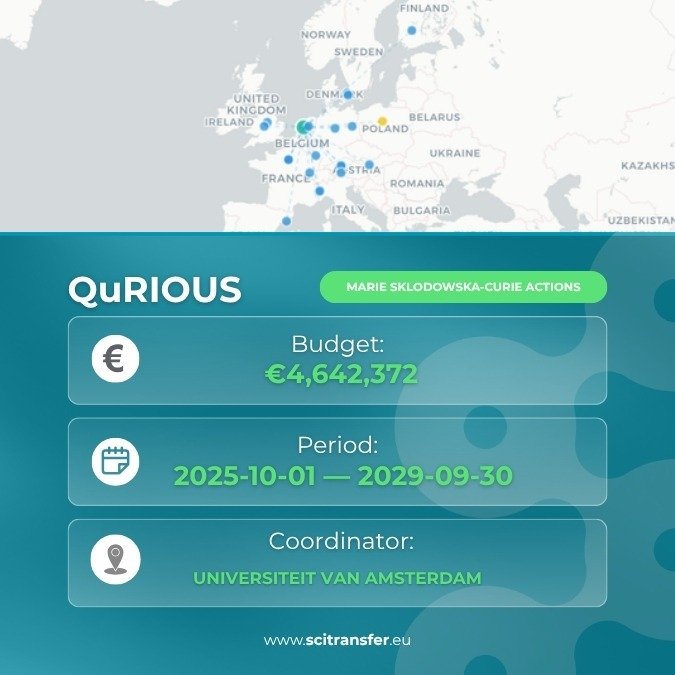
On 24 June 2025 the European Commission signed off on a four-year, €4.64 million doctoral network called QuRIOUS — Quantum Research and Innovation in Optical clocks for Upcoming Scientists — that will train fifteen PhD researchers across some of the continent’s leading quantum laboratories, metrology institutes and photonics companies. The programme starts on 1 October 2025, runs until 30 September 2029, and is coordinated by the University of Amsterdam under the Marie Skłodowska-Curie Actions Doctoral Networks scheme. The first researchers have already arrived at their host labs in Munich and Besançon.
Behind the formalities of a Horizon Europe grant agreement (ID 101227522, DOI 10.3030/101227522) sits a simple strategic question: who, in the next decade, will know how to build, miniaturise and field-deploy the clocks on which much of the modern economy will quietly depend?
Why a clock matters more than it sounds
Optical clocks are the descendants of the caesium atomic clocks that have defined the second since the 1960s, but they operate at vastly higher frequencies — using laser light tuned to extraordinarily narrow atomic transitions. The result is timekeeping accurate, in the best laboratory devices, to about one part in a quintillion: a million million million.
That accuracy is not an end in itself. It is a substrate.
Modern positioning, navigation and timing — the satellite-derived signals that route aircraft, time financial trades, synchronise mobile networks and stamp the moment when one bank pays another — relies on atomic timekeeping that is, by today’s research standards, comparatively coarse. The QuRIOUS consortium points to an uncomfortable figure: roughly 10 percent of Europe’s gross domestic product depends on satellite navigation systems, and those systems are physically and geopolitically fragile. A jammed signal over the Baltic, a damaged satellite, a coordinated attack on space infrastructure — each is a non-trivial economic event.
Optical clocks offer an alternative. Embedded in a fibre-optic telecommunications network, they can distribute precise time across a continent without depending on a satellite at all. They can also detect minute changes in Earth’s gravitational field — the discipline known as relativistic geodesy — making them uniquely useful for monitoring sea-level rise, magma movement and the redistribution of ice. And they remain a workhorse of fundamental physics: the science underpinning their development has been recognised, the consortium notes, by Nobel Prizes in 1997, 2001, 2005, 2012 and 2022, with five European laureates among the recipients.
The market is following the physics. The QuRIOUS partners cite estimates that the broader quantum-device market will reach roughly €3 billion by 2030, with quantum clocks accounting for around 40 percent of the quantum sensing segment.
What QuRIOUS will actually do
The fifteen doctoral projects sit at the practical end of the field. Where earlier European networks pushed the underlying physics, QuRIOUS is unmistakably oriented toward clocks that can leave the optical bench: transportable systems, robust subsystems, and the engineering know-how that turns a Nobel-grade experiment into something that can sit in a telecom exchange or a mobile container.
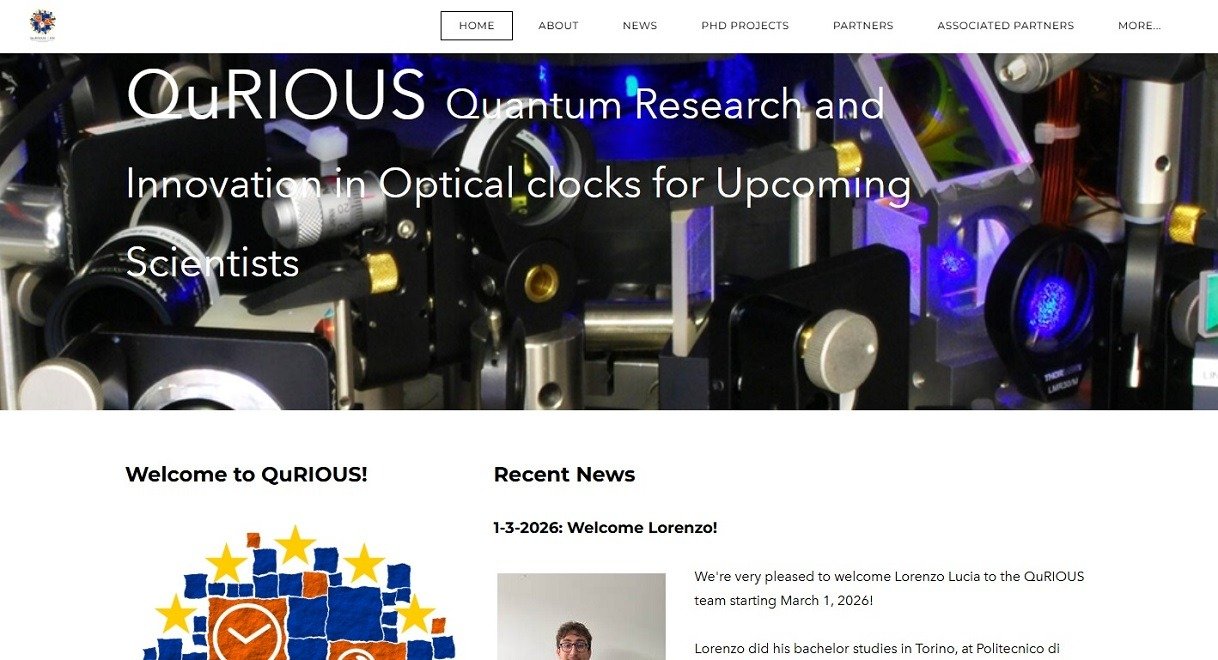
Some of that work has begun. In March 2026 the network welcomed Lorenzo Lucia, a quantum-engineering graduate of Politecnico di Torino with research experience at INRIM, Italy’s national metrology institute, where he worked on entangled photon sources from silicon-nitride microrings. He is now based at Menlo Systems in Munich — a German manufacturer of optical frequency combs and a key industrial partner — as researcher R13-MEN.
A month later Bhagyashri Bidwai joined the consortium at the FEMTO-ST Institute (CNRS) in Besançon, France, after master’s work at Savitribai Phule Pune University and at the Raman Research Institute in Bangalore. Her doctoral project sits at the visible edge of the field: a continuously operating superradiant laser based on ultracold ytterbium atoms coupled to an optical cavity, exploring the ¹S₀ → ³P₀ clock transition as a route to ultra-stable optical frequency references.
Other host laboratories cover much of the continent. Doctoral students will be based at the universities of Amsterdam, Birmingham, Copenhagen, Toruń (Nicolaus Copernicus University), Vienna (TU Wien) and Innsbruck; at three CNRS sites in France — in Paris, Villetaneuse and Besançon — and at INRIM in Italy. Industrial partners include Menlo Systems and QUBIG in Germany and NKT Photonics in Denmark. A further eleven associated partners — among them Germany’s PTB, ICFO in Barcelona, Humboldt University of Berlin, Observatoire de Paris and the quantum-software startup Qruise — round out the network. Recruitment is ongoing; at the time of writing, applications were still open for position R7 at CNRS-LTE.
A live overview of the consortium and its open positions is maintained at quriousclocks.eu.

The lineage
QuRIOUS does not appear out of nowhere. It is the third in a sequence of EU-funded efforts on optical clocks that have, between them, shaped Europe’s posture in the field. The first, MoSaiQC, is a doctoral training network currently educating 16 PhD students on optical atomic clocks. The second, the iqClock collaboration, transitioned into AQuRA — a project specifically aimed at making optical quantum clocks ready for industrial use. QuRIOUS picks up that thread and pushes it further into deployment, training, and the integration of academic research with industrial scale-up.
“Optical clocks are becoming central to many areas of science and industry. QuRIOUS will prepare young scientists to drive the next wave of quantum innovation.”
— Florian Schreck, University of Amsterdam, QuRIOUS coordinator
What it costs, and what Europe gets back
The headline figure is €4,642,371.72 — the European Commission’s full contribution under the HORIZON-TMA-MSCA-DN funding scheme. Spread across 22 partner organisations, that is an average of roughly €211,000 per partner. By the metrics that the EU’s own project mapping uses, QuRIOUS is around eight times the average size of an MSCA mobility project and ranks in the top 1 percent of the 6,689 projects in its topic area.
What it buys is less obvious than a piece of hardware, but arguably more durable: fifteen scientists who, by 2029, will have been trained jointly by academia, by national metrology institutes and by industry, in a discipline where Europe still leads. Some will stay in research. Others will move into the photonics companies that are already turning optical-clock subsystems — frequency combs, ultra-stable lasers, vacuum systems — into products. Either way, the expertise stays inside the European ecosystem.
That is the strategic logic. Quantum clocks are not glamorous in the way that a quantum computer is. They will not write you an essay or fold a protein. What they will do is keep working — invisibly, accurately, continuously — in the infrastructure that everything else sits on top of. And in 2026, knowing how to build them, where to put them, and who can be trusted to maintain them is no longer an academic question.
Europe has decided it would rather know the answer.
Sources:
- https://www.quriousclocks.eu/
- https://iop.uva.nl/content/news/2025/07/qurious-a-new-doctoral-programme-on-optical-quantum-clocks.html?cb
- https://cordis.europa.eu/project/id/101227522
- https://map.scitransfer.eu/project/qurious-101227522
Autor: Radoslav Todorov
Images: canva.com, scitransfer.eu, quriousclocks.eu