
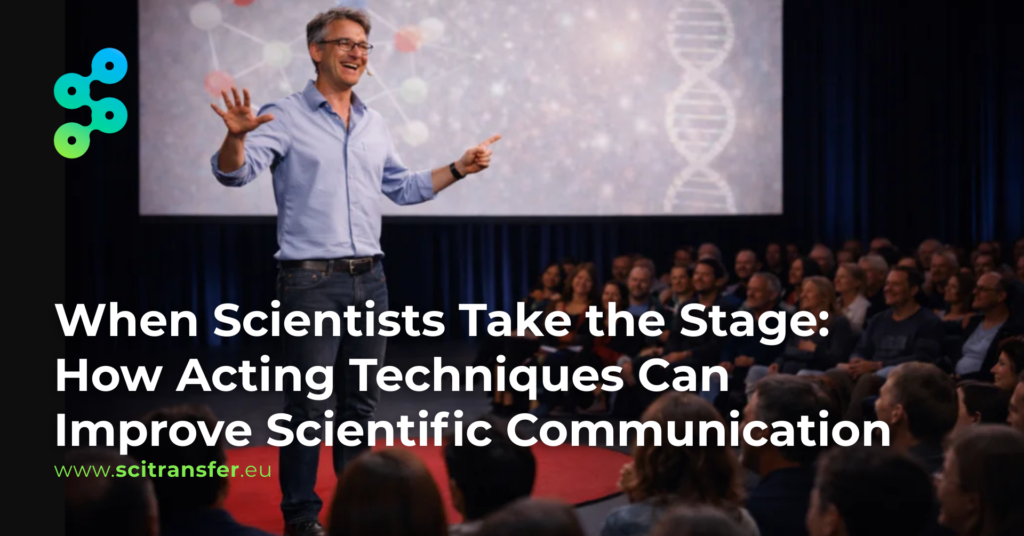
There is a paradox in contemporary science: never before have its ideas been so important—and never before has the public’s attention been so difficult to attract and sustain.
Many scientists possess deep expertise, but when they stand before an audience—especially outside an academic context—they sound monotonous, cautious, sometimes even distant, or in other words, boring to the public. This is not so much due to a lack of passion as to a lack of stage awareness.
An article in Nature addresses precisely this problem: scientists often communicate as if they are writing a scientific paper, rather than speaking to living people standing in front of them. The result is that complex ideas—no matter how significant—lose part of their force in the process of being conveyed to the audience.
And communication is part of science itself. Without it, a discovery does not reach society but remains confined to the laboratory.
What does the stage know that science overlooks?
Actors work with text—just as scientists do. But they understand something fundamental: words alone are never enough. Meaning is born in rhythm, pause, intonation, facial expression, and bodily movement.
The same line can be flat or electrifying depending on the tempo and the tension that precedes it. A dramatic pause of two or three seconds can make a sentence more powerful than ten additional supporting facts.

This is not a theatrical ornament. It is a cognitive mechanism. Research in neuroscience—for example the work of Uri Hasson and his colleagues “A neural coupling mechanism for communication between speaker and listener.”—shows that during a well-told story, the brains of speaker and listener begin to synchronize. Storytelling literally “connects” people at a neural level.
And monotonous speech? It leaves the brain without orientation.
When there is no contrast—there is no attention.
When there is no rhythm—there is no tension.
When there is no pause—there is no time for understanding.
Why Humor and Dynamism Do Not Diminish Science
Many scientists fear that if they become more entertaining or more expressive, they will appear less serious. But seriousness is not a function of lack of expression.
Humor—measured, intelligent, contextual—reduces cognitive strain. It opens a space in which complex ideas become more bearable and more memorable. Psychological research on attention and memory, popularized for example by John Medina in Brain Rules, shows that emotional context improves information retention.
This is not about stand-up comedy. It is about human presence.
Some scientists do this naturally. Brian Cox and Neil deGrasse Tyson are examples of how complex physics or cosmology can be presented with energy and ease, without compromising content. The TED platform has for years demonstrated that scientific depth and stage mastery are not opposites. On the contrary—they reinforce one another.

Science as a Directed Narrative
My conviction is that scientists can significantly improve their public speaking if they adopt from actors not only technique, but also mindset.
– To model their tempo consciously.
– To use the pause as a tool.
– To build contrast between problem and solution.
– To introduce tension before revealing a result.
– To “read” the audience and sense when attention begins to drift.
The techniques of performers—rhythm, contrast, emotional dynamics, sensitivity to the reaction in the room—do not make science less serious. They make it more accessible. More memorable. More impactful.
A complex idea should not simply be stated. It should be experienced. When a scientist directs their own presentation, they are in fact respecting the time and attention of the audience.
Good examples of this already exist in abundance. The British physicist Brian Cox often structures his lectures as a dramatic narrative—beginning with almost childlike wonder at the Universe, slowing the pace when explaining a fundamental idea, and using pauses before key conclusions so that the audience can “inhale” the scale of the topic.
Neil deGrasse Tyson (American astrophysicist, author, and public science communicator), by contrast, works with humor and tonal contrast—he poses a question, makes a brief pause, raises his tone at an unexpected moment, and thus transforms abstract cosmology into a conversation. And within the TED platform, many scientists use a classic stage device: they begin not with a definition, but with a scene—a personal moment in the laboratory, a failure, a doubt—and only then unfold the theory. This is pure dramaturgy: introduction, tension, climax, resolution. And it works.
Brian Cox at The Economist Technology for Change Asia in 2025.
In an Age of Noise—The Voice Matters
Today science competes not only with other scientists, but with algorithms, sensational headlines, and disinformation. In such an environment, it is not enough to be right. You must be heard.
Public speaking is no longer an additional skill. It is part of scientific responsibility. If society does not understand the complex processes behind vaccines, climate, artificial intelligence, or nuclear safety, the vacuum will be filled by other voices—voices that may prove deeply harmful and even dangerous.
Perhaps, then, it is time for more scientists to do something that at first glance seems unusual: to take an acting course.
Not to become performers.
But to become better translators of their own science.
Neil deGrasse Tyson’s Q&A @ Overheard
Author: Radoslav Todorov
Images: canva.com, wikipedia.org, AI
Main sources:
- What scientists can learn from actors about public speaking, Nature (2025)
https://www.nature.com/articles/d41586-025-04166-2 - Stephens, G. J., Silbert, L. J., & Hasson, U. (2010).
A neural coupling mechanism for communication between speaker and listener.
Proceedings of the National Academy of Sciences (PNAS)
https://www.pnas.org/doi/10.1073/pnas.1008662107 - Medina, J. (2008). Brain Rules: 12 Principles for Surviving and Thriving at Work, Home, and School.
https://brainrules.net/brain-rules-book/ - TED – Official Conference Platform
https://www.ted.com