
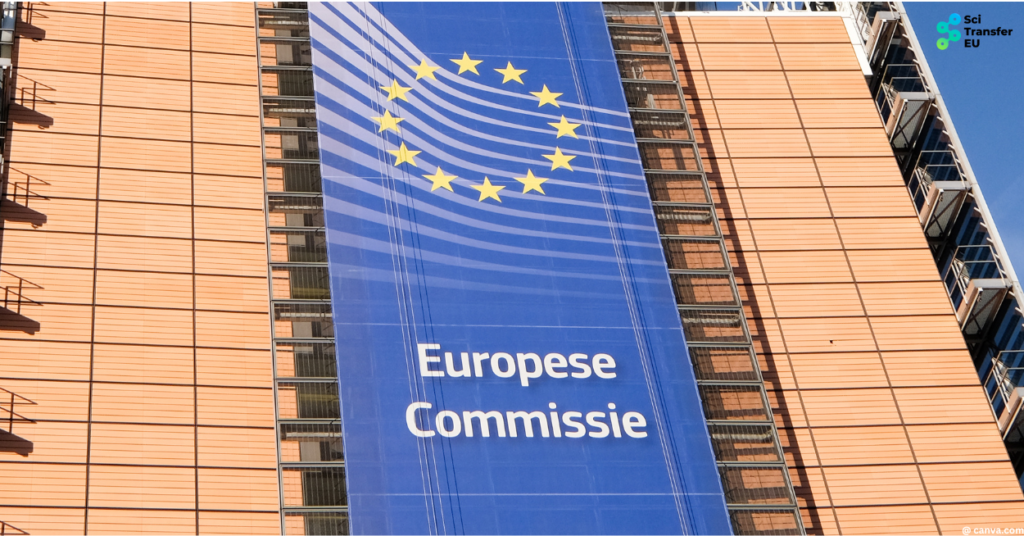
Communication in EU-funded projects is no longer a peripheral task. It is a legal obligation, a strategic tool – and, if handled poorly, a real source of financial risk. One of the most frequently asked questions by beneficiaries and communication teams may sound simple but is tricky in practice: when must the European Commission be informed about a communication activity – and when is that not necessary?
Visibility Is Mandatory – Involvement of the Commission Is Conditional
The first and most important distinction is between the obligation to ensure visibility and the need to inform or involve the European Commission. All beneficiaries, regardless of the programme or management model, are required to acknowledge EU funding – through the EU emblem, the appropriate funding statement, and accurate project information. This is an unconditional, legally binding obligation.
Quite different is the question of whether a specific communication activity requires coordination, prior notification, or active involvement of the Commission or managing authority. The rules explicitly state that the Commission’s involvement depends on “the programme and the specific activity” – it is not required for every public communication.
In practice, this means that most routine project communications fall within the autonomy of the beneficiary – as long as they are accurate, proportionate, and comply with EU visual identity guidelines.
When Should the European Commission Be Informed?
For Communication Activities of Strategic Importance
The clearest and most straightforward cases involve communications related to:
- operations of strategic significance;
- projects with very large budgets;
- activities with high public or media visibility.
According to Regulation (EU) 2021/1060 and national beneficiary guidelines, in such instances, beneficiaries are required to involve the Commission and/or the managing authority in a timely manner. This applies, for example, to:
- official inaugurations;
- major public events;
- key milestones with societal relevance.
The reasoning here is not bureaucratic, but political and communicative: the EU wants to be visible where the impact is most significant.
When There Are Breakthroughs or Success Stories
This is especially relevant for directly managed programmes like Horizon Europe. Beneficiaries are actively encouraged: “Have you made a breakthrough discovery? Have you been featured in the press? Don’t forget to inform your project officer!”
In this context, informing the Commission is not about seeking prior approval – it’s about offering the opportunity for your result to be amplified via official EU channels.
In other words: if your news could become a European “success story”, don’t let it remain buried on your project website.
For Joint Communication Campaigns and Co-Branding
If your communication activity:
- uses joint branding (e.g. EU + national authorities);
- aims for coordinated messaging aligned with EU policy priorities (e.g. the Green Deal, digital transition);
then the involvement of the Commission or managing authority is recommended – and often required – to ensure message coherence and appropriate positioning of the project within a wider political context.
When Is It Not Necessary to Inform the Commission?
For Routine, Day-to-Day Project Communication
A common misconception among beneficiaries is that “every publication needs approval.” This is not true.
The following activities do not require prior notification or approval – provided that visibility rules are properly followed:
- regular posts on social media;
- project news updates on the website;
- newsletters and internal events;
- standard invitations, posters, and information materials.
The EU’s social media guidance explicitly underlines the autonomy of project teams in daily communication – as long as it is correct, accessible, and visually aligned with EU standards.
When There’s No Political or Strategic Context
If your communication:
- does not involve a national or EU-level political message;
- does not present the project as a flagship initiative;
- does not include senior-level participants;
then the role of the Commission is passive, not operational. The EU must be visible – but it does not need to be a participant in every post.
A Simple Rule of Thumb
For practical orientation, many communication teams use a simple but effective rule:
If the communication is relevant mainly for the project’s audience – there’s no need to inform the Commission.
If it could serve as an example of European policy or success – inform them.
This approach reflects not the formal, but the functional boundaries of the system. The European Commission doesn’t expect to be notified about every flyer – but it does want to be a partner where EU added value is most visible.
Understanding when to inform the Commission – and when not to – helps avoid unnecessary bureaucracy, while also preventing real mistakes with potential financial consequences.
The bottom line is simple:
Not everything needs to go to Brussels – but the best should never stay hidden.
Main Sources:
- Communication and visibility rules
- European Commission / REA – Are you communicating your Horizon Europe project?
https://research-and-innovation.ec.europa.eu - European Commission / REA – Communicating about your research project on social media
https://research-and-innovation.ec.europa.eu - Beneficiary Guide for Visibility, Transparency and Communication 2021–2027
https://www.eufunds.bg - Law on the Management of EU Funds under Shared Management (Bulgaria)