

In the transition towards a fully digitalised industrial future, communication systems are becoming as critical as the machines they connect. Modern factories are no longer isolated production lines but dynamic, data-driven ecosystems where milliseconds matter and reliability is essential.
Against this backdrop, the EU-funded SPRINTER project is advancing the next generation of industrial communication—making networks faster, more flexible, and significantly more energy-efficient.
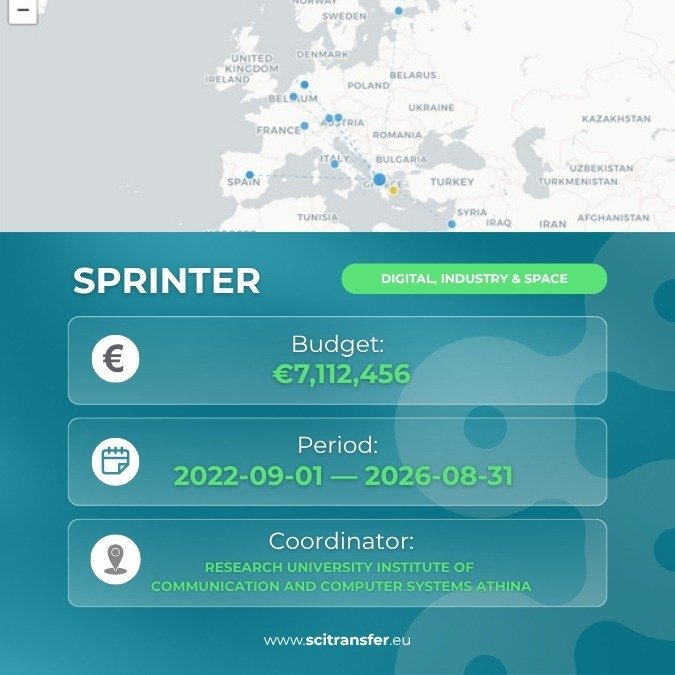
Funded under the Horizon Europe programme, SPRINTER benefits from nearly €6 million in EU contribution within a total budget exceeding €7.1 million. The project—Low-cost and energy-efficient hybrid photonic integrated circuits for fibre-optic, free-space optical and mmWave communication systems supporting time-critical networking in industrial environments—brings together leading European stakeholders to move advanced photonic technologies closer to industrial deployment.
A Hybrid Approach to Industrial Connectivity
SPRINTER addresses a key challenge in modern industry: ensuring ultra-fast and reliable communication across complex and dynamic environments.
Traditional wired networks offer high stability but limited flexibility, while wireless solutions provide mobility at the cost of potential latency and reliability issues.
To overcome these limitations, SPRINTER is developing a hybrid communication platform that integrates fibre-optic links, free-space optical communication, and millimetre-wave (mmWave) wireless technologies. This combined approach enables industrial networks to leverage the strengths of each technology while compensating for their individual constraints.
By integrating these communication modes through advanced photonic technologies, SPRINTER enables seamless connectivity across indoor and outdoor environments—supporting stationary equipment, mobile robots, and temporary industrial setups alike.

Photonic Integration as a Key Enabler
At the core of SPRINTER’s innovation are photonic integrated circuits (PICs), which use light rather than electrical signals to transmit and process data. This allows for significantly higher data rates and improved energy efficiency compared to conventional electronic systems.
The project is developing optical transceivers capable of reaching data rates of up to 200 Gb/s, alongside wavelength-tunable transceivers operating at 10 Gb/s. These components are designed with cost-efficiency and scalability in mind, supporting their future adoption in industrial environments.
SPRINTER also explores advanced fabrication techniques for three-dimensional photonic integration, enabling highly compact and efficient devices. Among these is a reconfigurable optical add-drop multiplexer designed to maintain performance under demanding industrial conditions, including minimal signal loss and robustness to polarisation effects.

Supporting Time-Critical Industrial Applications
Industrial processes increasingly rely on time-critical networking, where even minor delays or data loss can have significant operational consequences. This is particularly relevant for applications such as closed-loop control systems in smart factories.
SPRINTER is developing a unified network platform capable of deterministic communication, ensuring that data is delivered within guaranteed timeframes and with consistent quality of service.
To validate its approach, the project is demonstrating its technologies in a real industrial environment, including the deployment of a closed-loop control system. These demonstrations provide critical insights into performance under realistic operating conditions.
From Innovation to Industrial Deployment
As a Horizon Europe Innovation Action, SPRINTER places strong emphasis on practical implementation. Beyond research, the project focuses on prototyping, piloting, and validating its technologies in real-world scenarios.
The consortium reflects this ambition. Coordinated by the Institute of Communication and Computer Systems (ICCS) in Athens, SPRINTER brings together 13 partners from across Europe and beyond. These include leading research organisations such as Fraunhofer and imec, major industry players including Ericsson and Intracom Telecom, and specialised photonics companies such as PHIX and LioniX International.
This multidisciplinary collaboration ensures a clear pathway from technological development to industrial adoption.
Contributing to Europe’s Digital and Industrial Strategy
SPRINTER contributes directly to Europe’s priorities in digital transformation, sustainability, and technological sovereignty.
By enabling high-performance, energy-efficient communication systems, the project supports the development of smart factories, autonomous systems, and advanced manufacturing processes. Its hybrid architecture offers a scalable and adaptable solution for diverse industrial environments.
At the same time, SPRINTER strengthens Europe’s position in key enabling technologies by fostering collaboration across research and industry and advancing the development of photonic solutions within the European ecosystem.

Looking Ahead
Running from September 2022 to August 2026, SPRINTER is now entering a critical phase of validation and demonstration. As results emerge, the project is expected to provide concrete evidence of how hybrid photonic communication systems can transform industrial networking.
By combining performance, flexibility, and energy efficiency, SPRINTER has the potential to set new benchmarks for industrial communication infrastructure—supporting a more connected, competitive, and sustainable European industry.
Autor: Radoslav Todorov
Images: canva.com, scitransfer.eu, horizon-de-sprinter.eu
Sources: