
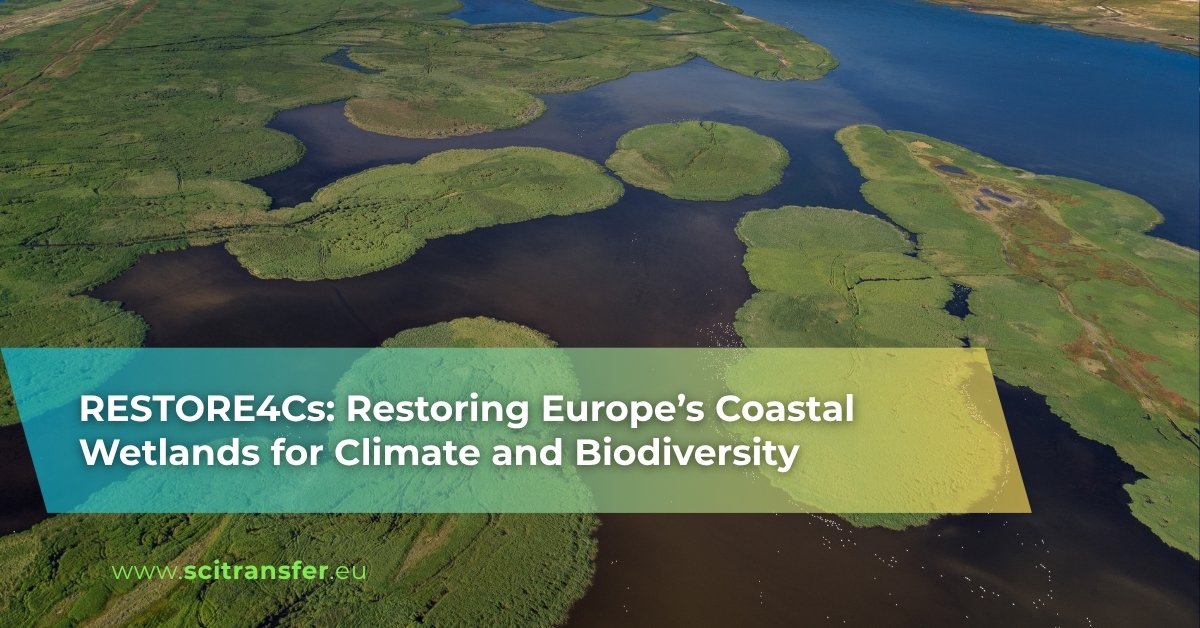
Across Europe’s coastlines, a powerful yet often underutilised climate ally has long remained in the background of environmental policy and investment priorities. Salt marshes, seagrass meadows, and peatlands—collectively referred to as coastal wetlands—are among the most valuable ecosystems on the continent. They store significant amounts of carbon, act as natural buffers against coastal erosion, and support a wide range of biodiversity, including many species of ecological and economic importance.
Despite their value, decades of land-use change, urbanisation, pollution, and unsustainable management practices have significantly reduced their extent and functionality. As a result, their capacity to deliver climate, ecological, and societal benefits has been weakened at a time when such services are more critical than ever.
The Horizon Europe project RESTORE4Cs responds directly to this challenge. Its central ambition is clear: to demonstrate how restoring coastal wetlands can simultaneously address climate change mitigation and adaptation, biodiversity loss, and increasing coastal vulnerability across Europe.
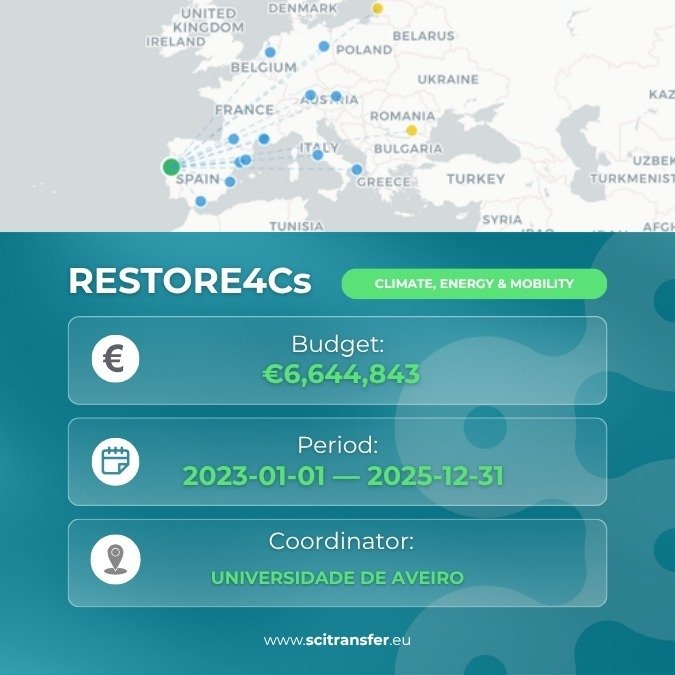
Funded with approximately €6.6 million under the Horizon Europe programme, RESTORE4Cs (2023–2025) is coordinated by the University of Aveiro (Portugal) and brings together a consortium of 16 partners from across Europe. Its full title—Modelling RESTORation of wEtlands for Carbon pathways, Climate Change mitigation and adaptation, ecosystem services, and biodiversity co-benefits—highlights both the scientific depth of the project and its strong alignment with European policy priorities.
Coastal Wetlands as High-Impact Nature-Based Solutions
Coastal wetlands are increasingly recognised as high-impact nature-based solutions capable of addressing multiple environmental challenges simultaneously. Their ability to capture and store carbon—often referred to as “blue carbon”—places them among the most efficient natural carbon sinks on Earth. Carbon is accumulated in both vegetation and sediments, where it can remain stored for centuries under stable conditions.
However, this capacity is highly sensitive to ecosystem health. When wetlands are degraded or destroyed, they can shift from carbon sinks to carbon sources, releasing previously stored greenhouse gases back into the atmosphere. This dual role makes their restoration not only an environmental priority but also a strategic climate action.
RESTORE4Cs addresses this complexity by systematically analysing how restoration interventions influence both carbon sequestration and emissions. In addition, the project evaluates a broader set of ecosystem services, including flood regulation, shoreline stabilisation, and habitat provision.
A defining feature of the project is its integrated socio-ecological systems approach. Rather than examining climate, biodiversity, and human well-being in isolation, RESTORE4Cs considers them as interconnected and interdependent outcomes. This approach reflects the realities faced by policymakers, regional authorities, and coastal managers, who must balance environmental objectives with economic and social considerations.
To ensure robust and transferable results, the project is grounded in six pilot sites across Europe. These sites represent a diverse range of ecological conditions and management histories—from relatively undisturbed wetlands to heavily degraded areas undergoing active restoration. By comparing these contexts, RESTORE4Cs is able to identify best practices and key success factors.
These case studies are complemented by comprehensive meta-analyses of existing datasets, strengthening the scientific evidence base and enabling broader generalisation of findings across different European regions.
From Data to Decisions: A European Decision Support System
One of the most forward-looking components of RESTORE4Cs is its focus on transforming scientific knowledge into practical tools for decision-making. At the centre of this effort is the development of an integrated Decision Support System (DSS).
The DSS combines advanced methodologies—including remote sensing, machine learning, and ecological modelling—to provide a user-oriented platform tailored to the needs of policymakers, planners, and environmental practitioners.
Through this platform, stakeholders will be able to:
- Identify priority areas where restoration delivers the greatest combined environmental and socio-economic benefits
- Evaluate trade-offs between different ecosystem services under various management scenarios
- Assess long-term impacts on carbon storage, greenhouse gas emissions, and ecosystem resilience
Importantly, the system is designed with scalability in mind. RESTORE4Cs extends its modelling framework to the European level and incorporates additional wetland types, such as floodplains and peatlands. This enables the development of a comprehensive, harmonised assessment of wetland status and restoration potential across Europe.
Beyond its technical capabilities, the DSS is intended as a bridge between science and policy. By translating complex data into accessible insights, it supports more informed investment decisions and contributes to the effective implementation of key EU frameworks, including the European Green Deal and the EU Biodiversity Strategy.
In parallel, the project is establishing a Community of Practice that brings together scientists, policymakers, NGOs, and practitioners. This network facilitates knowledge exchange, promotes collaboration, and ensures that project outputs are actively used rather than remaining confined to academic contexts.
Supporting Policy and Delivering Societal Benefits
RESTORE4Cs is closely aligned with Europe’s strategic objectives in climate action, biodiversity conservation, and sustainable development. A central contribution of the project is the development of standardised methodologies for assessing and prioritising wetland restoration.
Such standardisation is essential for enabling consistent comparisons across regions and supporting evidence-based policymaking at both national and EU levels. Without harmonised approaches, it becomes difficult to evaluate progress, allocate resources efficiently, or design coherent strategies.
Beyond its policy relevance, the project highlights the tangible benefits that restored wetlands can provide to society. These include:
- Reduced flood risk and increased resilience in coastal communities
- Enhanced protection against shoreline erosion and storm surges
- Improved fisheries productivity and support for local economies
- Better water quality through natural filtration processes
These benefits demonstrate that wetland restoration is not only an environmental intervention but also a socio-economic investment. By strengthening ecosystem functions, RESTORE4Cs contributes to more resilient and sustainable coastal regions.

A Scalable Model for Future Research and Investment
With a total budget of €6,644,843 and a duration from January 2023 to December 2025, RESTORE4Cs represents a significant and strategic investment in Europe’s environmental future.
Its true added value lies in its ability to operate across scales and domains. The project connects local pilot experiences with continental-level assessments, integrates ecological science with socio-economic considerations, and links research outputs with policy needs.
By combining scientific rigour with practical applicability, RESTORE4Cs provides a model for how collaborative research can generate actionable knowledge and support real-world decision-making.
As Europe intensifies its efforts to meet climate targets and halt biodiversity loss, the importance of nature-based solutions continues to grow. Coastal wetlands, in particular, offer a unique opportunity to deliver multiple benefits simultaneously.
RESTORE4Cs demonstrates that the solutions are already present within natural systems. The key challenge is to understand where restoration efforts will have the greatest impact, how they should be implemented, and how their benefits can be maximised over time.
By addressing these questions, the project goes beyond advancing scientific understanding—it helps redefine the role of coastal wetlands in Europe’s transition towards a more sustainable, resilient, and climate-neutral future.
Autor: Radoslav Todorov
Images: canva.com, scitransfer.eu, restore4cs.eu
Sources: