

Across Europe, millions of people live with chronic conditions that require long-term rehabilitation. From Parkinson’s disease to spinal disorders and joint replacements, recovery is rarely linear—and never identical from one patient to another. Yet, many rehabilitation programmes still rely on standardised approaches that fail to reflect individual variability.
The EU-funded PREPARE project is working to change this paradigm by placing artificial intelligence and data-driven insights at the centre of rehabilitation design and delivery.
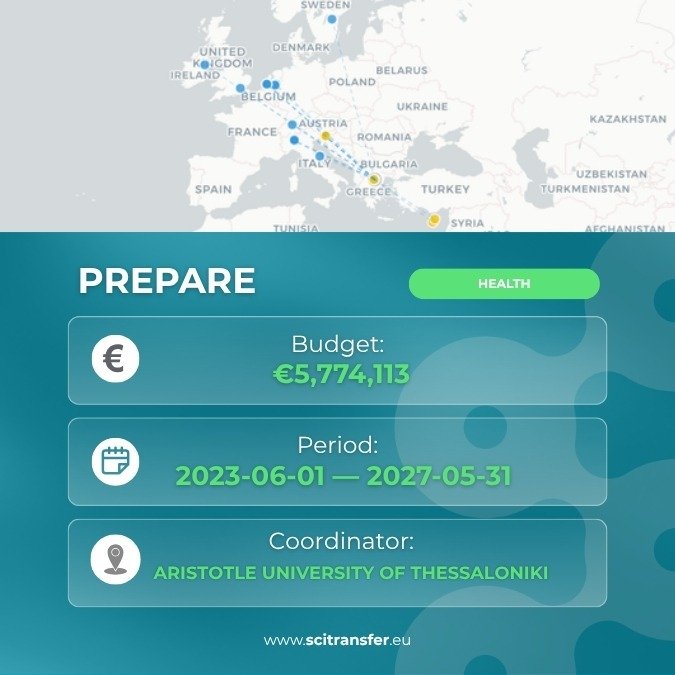
Funded under Horizon Europe with a total budget of €5.77 million, PREPARE (Personalised Rehabilitation via Novel AI Patient Stratification Strategies) brings together 20 partners across Europe. Coordinated by the Aristotle University of Thessaloniki, the consortium includes leading universities, research institutes, clinical centres, and professional organisations from countries including the Netherlands, Italy, Slovenia, Sweden, Ireland, Cyprus, Switzerland, and the United Kingdom.
Running from June 2023 to May 2027, the project aims to fundamentally reshape how rehabilitation strategies are developed, delivered, and scaled.
Moving Beyond One-Size-Fits-All Care
At its core, PREPARE is built on a simple premise: rehabilitation should be tailored to the individual.
Today, patients with similar diagnoses are often treated using comparable protocols, despite significant differences in recovery trajectories. Factors such as age, lifestyle, socio-economic conditions, and behavioural patterns all influence how a patient responds to therapy.
PREPARE addresses this gap through patient stratification—grouping patients based on shared characteristics and predicted outcomes. By applying advanced machine learning techniques to large-scale datasets, the project identifies which interventions are most effective for specific patient profiles.
The goal is clear: to replace generic treatment plans with personalised, evidence-based care pathways.
This approach is particularly relevant for the nine conditions addressed by the project: hand disorders, hip and knee prostheses, intermittent claudication, lower limb loss, Parkinson’s disease and Parkinsonisms, scoliosis, spine disorders, temporomandibular joint disorders, and hypertension. Together, these represent some of the most prevalent and resource-intensive rehabilitation needs worldwide.
Harnessing Data for Better Outcomes
A key innovation of PREPARE lies in its use of diverse, multi-dimensional datasets. Beyond clinical indicators, the project integrates socio-demographic factors, living conditions, and behavioural data to build a more complete picture of each patient.
This broader perspective enables the development of more accurate predictive models—but it also introduces complexity. Variations in data quality, structure, and accessibility can limit the effectiveness of conventional analytical approaches.
To address this, PREPARE combines expertise across clinical research, public health, data science, and advanced statistics. Machine learning algorithms are used to detect patterns and identify predictors of successful outcomes, translating these insights into computational models that support clinical decision-making.
The result is a more precise approach to treatment selection—improving patient outcomes while optimising the use of healthcare resources.
Advancing Open Science and Collaboration
PREPARE is strongly aligned with European principles of open science. Its tools and methodologies will be validated through a data-sharing platform built on the European Health Data & Evidence Network (EHDEN).
This infrastructure enables researchers and clinicians to access, validate, and build upon the project’s results, fostering transparency and collaboration across the scientific community.
Rather than remaining confined to a single consortium or healthcare system, PREPARE’s outputs are designed for reuse and adaptation. This open approach accelerates innovation and ensures that the project’s impact extends well beyond its duration.
From Research to Real-World Impact
PREPARE is not only a research initiative—it is designed to deliver practical, real-world applications.
As a Horizon Europe Research and Innovation Action (RIA), the project includes pilot cases across all nine target conditions, demonstrating how AI-driven stratification can be implemented in clinical settings.
In parallel, PREPARE is developing a certification roadmap to support the integration of its tools into healthcare systems. By addressing regulatory and adoption pathways early, the project increases its potential for long-term uptake and scalability.
For healthcare professionals, this means enhanced decision-support tools, improved management of complex cases, and more efficient resource allocation. For patients, it translates into more effective therapies, faster recovery, and care that reflects their individual circumstances.

A European Effort with Global Relevance
The strength of PREPARE lies in its diverse and interdisciplinary consortium. Institutions such as Erasmus Medical Center, Linköping University, the University of Milan, and the Jožef Stefan Institute contribute extensive scientific expertise, while organisations like the European Society of Physical and Rehabilitation Medicine (ESPRM) and EUROSPINE ensure close alignment with clinical practice.
This pan-European collaboration enhances both the scientific robustness and the real-world applicability of the project. By integrating perspectives from different healthcare systems and populations, PREPARE is well positioned to deliver solutions that are scalable, adaptable, and globally relevant.
Redefining the Future of Rehabilitation
As European healthcare systems face growing pressure from ageing populations and rising rates of chronic disease, the need for more effective and efficient rehabilitation strategies is becoming increasingly urgent.
PREPARE offers a compelling response: a shift from standardised protocols to predictive, personalised care powered by data and artificial intelligence.
By transforming rehabilitation into a proactive, evidence-driven process, the project not only advances scientific knowledge but also delivers tangible societal value. Its success will ultimately be measured in improved quality of life for patients across Europe—and in its ability to set a new benchmark for patient-centred care in the 21st century.
Autor: Radoslav Todorov
Images: canva.com, scitransfer.eu, prepare-rehab.eu
Sources: