

In the vast silence of space, even the faintest traces of light may hold answers to one of humanity’s most profound questions: are we alone in the universe?
The EU-funded research project XSCOOPED—short for EXoplanet SpectrosCopy using 0-nOise Photon Energy Resolving Detectors—is built on the premise that these nearly imperceptible signals from distant planets may contain evidence capable of transforming our understanding of life beyond Earth.
Backed by €2.88 million under the Horizon Europe programme, XSCOOPED is a focused technological initiative addressing one of the most persistent challenges in modern astronomy: observing Earth-like exoplanets with sufficient precision to detect signs of life.
From Philosophical Question to Scientific Investigation
The question of extraterrestrial life has long been central to astronomy. Today, it is no longer purely philosophical. The discovery of exoplanets—planets orbiting stars beyond our solar system—has revealed that many worlds exist within so-called habitable zones, where conditions may allow liquid water to persist.
However, detecting life on these planets remains exceptionally challenging.
Scientists rely on identifying biomarkers—chemical signatures in a planet’s atmosphere that may indicate biological activity. These signatures are extracted from the spectrum of light emitted or reflected by the planet. Yet such signals are extraordinarily faint, especially when compared to the overwhelming brightness of their host stars.
XSCOOPED addresses this challenge directly, operating at the intersection of physics, engineering, and astronomy to unlock these weak signals with unprecedented precision.

Closing the Technology Gap in Exoplanet Detection
Current detector technologies, largely based on semiconductor systems, face two critical limitations: noise and limited energy resolution.
Noise—random fluctuations within the detector—can obscure already weak signals. At the same time, insufficient energy resolution limits the ability to distinguish between wavelengths of light, which is essential for identifying atmospheric chemical signatures.
This is not merely a technical constraint. It represents a major bottleneck for future large-scale missions, including NASA’s planned Habitable Worlds Observatory (HWO). Detector performance has been identified as a high-impact weakness that must be addressed before 2030 to fully realise the scientific potential of such missions.
XSCOOPED is designed to close this gap.
A Breakthrough in Photon Detection Technology
At the core of the project is the development of microwave kinetic inductance detectors (MKIDs)—a cutting-edge technology capable of detecting individual photons without introducing noise.
Unlike conventional detectors, MKIDs offer several key advantages:
- No dark current and no read noise, meaning they do not generate false internal signals
- Intrinsic energy resolution, allowing each photon’s energy to be measured directly
When a photon is absorbed, it generates thousands of excitations within the detector. This enables precise measurement of its energy and transforms each pixel into a highly sensitive analytical unit.
Rather than simply recording brightness, MKIDs allow each pixel to identify specific wavelengths of light—making it possible to detect biomarkers in exoplanet atmospheres.

The XSCOOPED team has already achieved significant milestones, including:
- Energy resolving power of R = 70 at 402 nm
- Development of advanced anti-reflection coatings
- Improved fabrication methods to increase production yield
The project now aims to deliver a 32,000-pixel MKID instrument capable of meeting—or exceeding—the requirements of the Habitable Worlds Observatory.
Target specifications include:
- Energy resolving power > 140 at 1 μm
- Absorption efficiency > 90%
- Negligible dark counts
- Pixel yield > 95%
Achieving these benchmarks would represent a major advance in observational astronomy.
Positioning Europe in Future Space Missions
While XSCOOPED is a European initiative, its impact is inherently global.
By advancing detector technology to approximately TRL5 by 2030, the project aligns closely with the development timeline of the Habitable Worlds Observatory. This creates a clear pathway for European-developed technology to contribute to one of the most ambitious space missions of the coming decades.
Such a contribution would reinforce Europe’s strategic position in space science and demonstrate the value of targeted, high-risk research funding under Horizon Europe.
Beyond space-based missions, the technology also holds strong potential for ground-based astronomy. MKIDs are expected to play a key role in high-contrast imaging systems on next-generation telescopes such as the Extremely Large Telescope (E-ELT), functioning both as wavefront sensors and focal plane detectors.
Project Structure and Funding
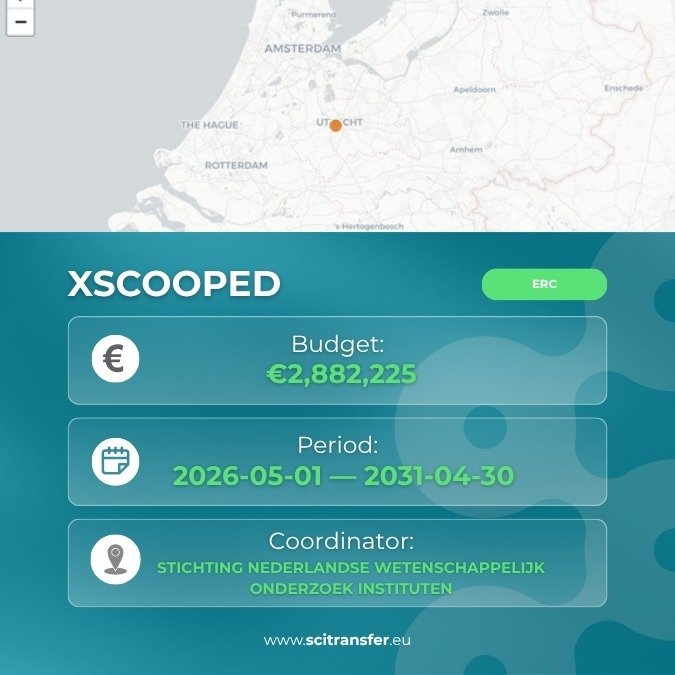
XSCOOPED is coordinated by the Stichting Nederlandse Wetenschappelijke Onderzoek Instituten (NWO-I), based in Utrecht, the Netherlands.
The project is funded under the Horizon Europe ERC-2025-COG scheme, with a total budget of €2,882,225. With a single participating partner and funding approximately 1.5 times above the topic average, the project reflects strong confidence in both its scientific ambition and technological feasibility.
Within the European Research Council portfolio, XSCOOPED ranks in the top 7% of projects in its domain.
The project runs from May 2026 to April 2031 and is currently in its initial phase.
Scientific and Societal Impact
While technically complex, the broader implications of XSCOOPED are clear.
From a scientific perspective, the project provides a pathway to overcoming one of the most fundamental observational barriers in astronomy. By enabling noiseless, energy-resolved spectroscopy, it brings researchers closer to directly detecting signs of life on distant planets—an achievement that would have profound implications across disciplines, from biology to cosmology.
From a societal perspective, the impact is equally significant. The search for extraterrestrial life continues to capture public imagination and inspire future generations of scientists and engineers.
Moreover, the technologies developed within XSCOOPED may extend beyond astronomy. Advances in ultra-sensitive detection systems could influence fields such as:
- Quantum technologies
- Medical imaging
- Environmental monitoring

Enabling the Next Era of Discovery
XSCOOPED does not promise immediate discoveries. Instead, it focuses on something more foundational: building the tools that make discovery possible.
In an era where major scientific breakthroughs depend on increasingly precise instrumentation, such work is essential. The ability to detect a single photon without noise—and to measure its energy with high accuracy—is not just a technical achievement. It is a gateway to entirely new observational capabilities.
If successful, XSCOOPED will not only enhance how we observe the universe—it will expand the very limits of what we can see within it.
And within that expanded view, the answer to one of humanity’s oldest questions may finally begin to emerge.
Autor: Radoslav Todorov
Images: canva.com, scitransfer.eu
Sources: