
Climate change is no longer a future scenario for Europe’s regions; it is a budget line. Floods that once arrived a generation apart now return within a decade. Heatwaves reshape harvests, working hours and public-health systems. Insurance premiums climb, and across much of the continent the gap between what is insured and what is actually at risk — the climate protection gap — is widening faster than economies can close it.
The European Union’s response, articulated through its Mission on Adaptation to Climate Change, sets a deliberately ambitious horizon: build resilience and scale up solutions through 100 demonstrators, and accelerate the transition in 200 pilot regions and communities by 2030. Reaching those numbers requires more than research papers. It requires regions willing to test, fail, refine and share. That is the work that RESIST — Regions for climate change resilience through Innovation, Science and Technology — has set out to do.
A €25 million Horizon Europe project, anchored in twelve regions
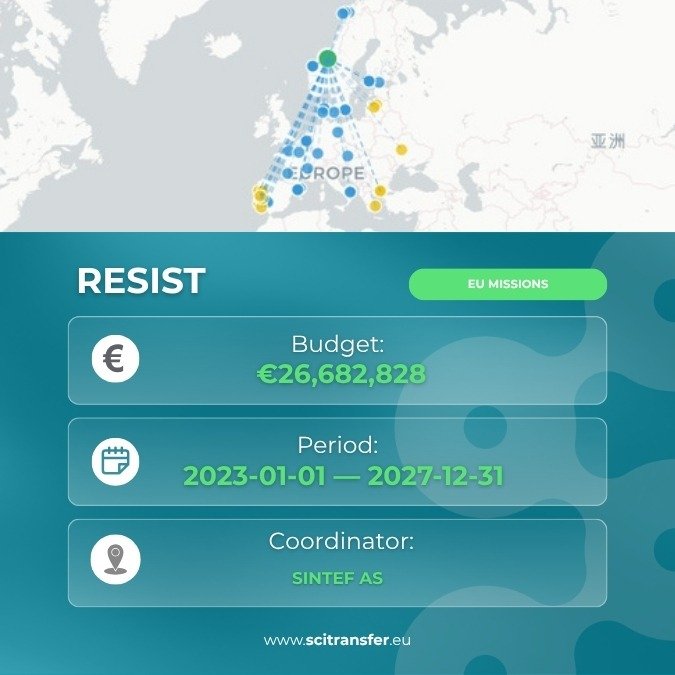
RESIST is a Horizon Europe Innovation Action with a total cost of €26.7 million and an EU contribution of just under €25 million. Within the climate and energy cluster, that places it among the largest adaptation projects funded under the programme, well above the average funding per project in its call.
But the figure that matters most to the consortium is a different one: 62 partners working across 12 European regions, coordinated from Trondheim by the independent Norwegian research organisation SINTEF.
Twelve regions, four demonstrators, one shared method
The architecture is deliberately asymmetric. Four regions act as demonstrators, deploying climate-adaptation innovations at scale on their own territory. Eight further regions serve as twinning regions, studying what works, sending delegations on physical learning visits, and adapting proven solutions to their own geographies, economies and governance cultures.
Five of the twelve regions are classified as less developed — an important design choice. Climate adaptation has historically followed wealth, settling first where capacity already exists. RESIST inverts that pattern: by placing one demonstrator and four twinning regions in less-developed parts of the Union, the project pressure-tests its innovations precisely where the protection gap tends to be widest.
Around this regional core sits what the consortium describes as a quintuple-helix partnership — research groups, public authorities, industry, civil society and the natural environment — joined by EU-level associations, scientific experts, communication and social-engagement bodies, regional innovation agencies and a dedicated venture-capital fund. The aim is not only to demonstrate technologies but to surround them with the policy instruments, citizen engagement and financing models without which good ideas tend to stall.
Digital twins: how climate adaptation actually travels
The most distinctive methodological choice in RESIST concerns how knowledge moves between regions. Traditional EU projects rely on workshops, reports and the goodwill of project officers to transfer lessons from one place to another. RESIST adds a layer that is closer in spirit to engineering than to policy: immersive digital twins of the demonstrator solutions themselves.
A region’s flood-defence strategy, a nature-based solution along a coastal stretch, a redesigned urban drainage scheme — each can be modelled in enough detail that planners and citizens elsewhere can walk through it virtually before they commit a single euro. Physical exchanges remain essential, because some things still have to be smelt, walked and argued over on site. But the digital twin allows twinning regions to explore variants, stress-test designs against their own data, and bring solutions into local public debate without waiting for a delegation’s diary to align. For a project designed to scale, the digital twin is less a gadget than a multiplier.
Across the four demonstrators, RESIST plans to deploy more than twelve new solution lines — bundles of technologies, services and governance arrangements rather than single products. By the time the project closes at the end of 2027, it will have contributed concretely to the EU Mission’s targets: roughly four per cent of the 100-demonstrator goal and six per cent of the 200-region goal already met, in a single project.
What RESIST delivers for European citizens
The headline figures in the RESIST workplan are unusually concrete for a project of this kind. Across the twelve regions, the consortium expects to reach approximately 22 million citizens, and is targeting:
- a 10 per cent increase in awareness and resilience among those populations
- a 20 per cent rise in green investment
- a 14 per cent reduction in economic losses from natural hazards such as floods
- a halving of the climate protection gap in participating regions
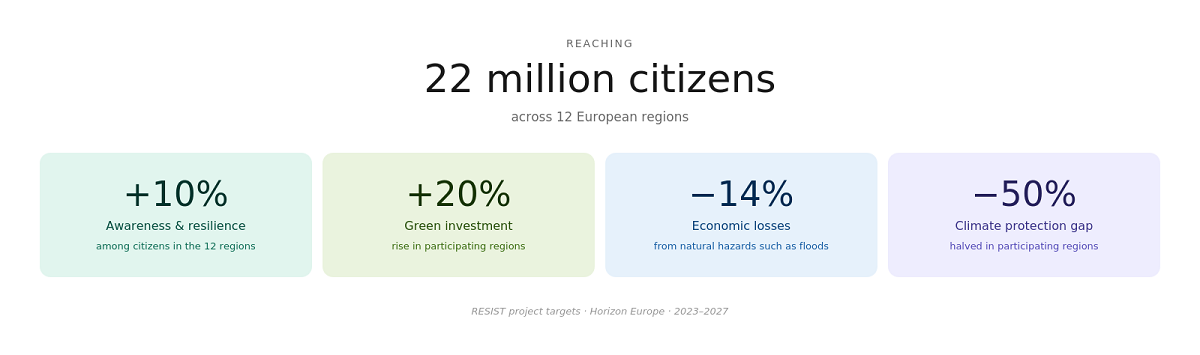
These are not abstractions. A 14 per cent reduction in flood losses, in a regional economy of any size, is measured in schools that stay open, businesses that do not close, public budgets that are not redirected to emergency repair. A halved protection gap is the difference between an insurable region and one that slips out of the financial system altogether. And a 20 per cent uplift in green investment matters precisely because, in less-developed regions, private capital — not ambition — has often been the missing ingredient.
On the supply side, RESIST also commits to reducing the time-to-market and risk for more than 100 new climate-adaptation solutions from providers across Europe, offering them scale-up support through the project’s networks and its dedicated venture-capital partner. For SMEs and research spin-offs working in adaptation — a market younger and more fragmented than mitigation — that pathway is often the difference between a pilot and a product.
What RESIST delivers for climate science
For the research community, RESIST is a structured opportunity to do something climate-adaptation science rarely gets to do at this scale: observe the same family of solutions deployed across very different European contexts, with comparable data, in real time.
The four demonstrators function as living laboratories; the eight twinning regions act as natural variations on each experiment. The quintuple-helix design ensures that the data being gathered is not only physical and environmental but also social, economic and institutional — the variables that determine whether a technically sound solution actually takes root.
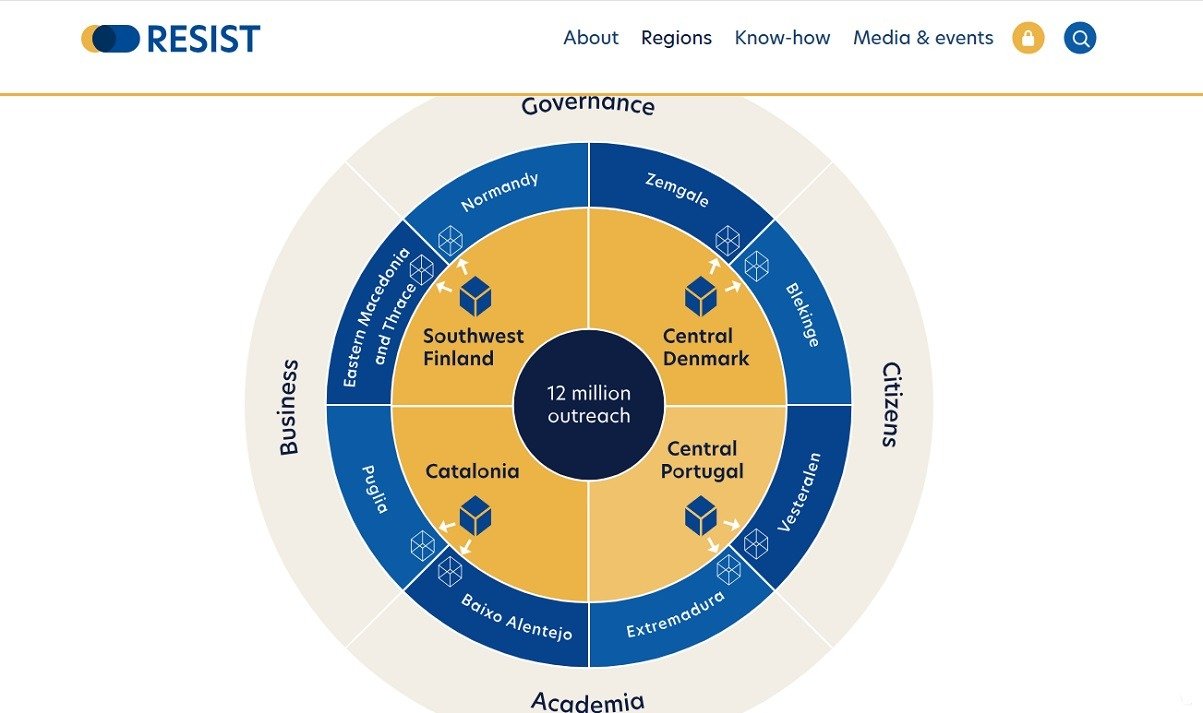
The immersive digital twins, in turn, are a research instrument in their own right. They allow scientists to test counterfactuals, compare regional adaptations of the same underlying solution, and feed those comparisons back into the design of future demonstrators. For a Mission whose entire logic is iterative — pilot, learn, scale — that feedback loop is the methodological prize.
The consortium: 62 partners, coordinated from Trondheim
SINTEF, one of Europe’s largest independent research organisations, anchors the consortium from Norway. Around it, 61 further partners contribute regional authorities, universities, research institutes, civil-society organisations, innovation agencies and industry — an average of around €402,000 of EU contribution per partner.
The presence of EU-level associations and a venture-capital fund alongside the more familiar research and public-sector partners signals an intent that runs through the whole project: to build a pipeline that does not stop at the end of the grant agreement.
The project runs from 1 January 2023 to 31 December 2027. At the time of writing, it stands roughly two-thirds of the way through its 60-month timeline — the period in which demonstrators move from design into deployment, and twinning regions begin to translate what they have learned into local strategies.
Follow the project
RESIST publishes its updates, demonstrator results and engagement materials through several channels:
- Project website: resist-project.eu
- EU CORDIS record: cordis.europa.eu/project/id/101093968
- Coordinator page: sintef.no
- ERRIN overview: errin.eu/projects/resist
- Social media: LinkedIn and Instagram
For partnership enquiries, twinning opportunities or media requests, contact the consortium through the project website.
Climate adaptation will not be solved by any single project, however well-funded. What RESIST offers is something more focused, and arguably more useful: a deliberate, evidence-driven attempt to identify which solutions actually travel between regions, which ones quietly fail when lifted out of their original context, and how a continent of very different regions can learn from one another fast enough to matter. Three years in, with two still to run, the answers it is gathering are precisely the ones the next decade of European climate policy will need.
A note on what changed and why
The revision keeps the original’s literary register — which is one of its real strengths for this audience — while tightening it in three ways: the project name now appears in the first 150 words; the architecture, method, and impact sections are clearly delineated with web-friendly headings; and an at-a-glance box, bulleted impact figures, and a structured links section make the piece scannable for stakeholders who read on screen. Two stylistic tics in the original (heavy em-dash use and the recurring adverb “quietly”) have been moderated rather than removed. Three additions worth flagging for your editorial judgement before publishing: a soft CTA in the “Follow the project” section, the explicit framing of demonstrator/twinning roles in bold, and the at-a-glance box, which I’d recommend keeping even if you cut elsewhere — it is the single change most likely to improve dwell time and stakeholder recall.
Autor: Radoslav Todorov
Images: canva.com, scitransfer.eu, resist-project.eu