
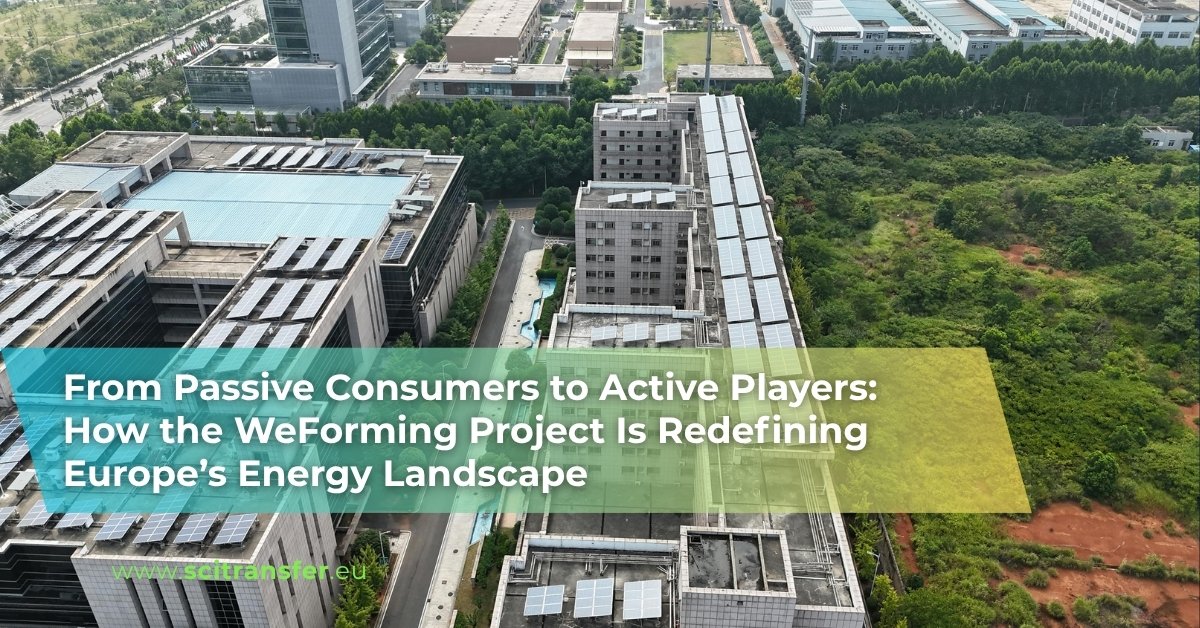
Across Europe, buildings account for a substantial share of energy consumption. Traditionally, they have operated as passive endpoints within a complex energy system. The Horizon Europe–funded project WeForming challenges this paradigm by transforming buildings into intelligent, responsive actors capable of shaping energy flows, supporting grid stability, and accelerating the transition to clean energy.
With a total budget of nearly €12 million—of which approximately €8.7 million is funded by the European Union—WeForming ranks among the most ambitious initiatives in the smart energy domain. Running from October 2023 to September 2026, the project brings together 32 partners from across Europe and beyond, coordinated by European Dynamics S.A. (Greece). Its mission is both technological and systemic in scope: to develop and demonstrate a new generation of buildings that actively participate in energy ecosystems.

A New Role for Buildings
At the heart of WeForming lies a simple but transformative idea: buildings should no longer merely consume energy—they should help manage it.
The project introduces the concept of Intelligent Grid-interactive Efficient Buildings (iGEBs). These buildings are equipped with advanced energy management systems capable of coordinating consumption, generation, and storage in real time. By responding dynamically to signals from energy grids and markets, they can balance supply and demand across multiple energy vectors, including electricity, heating, and cooling.
In practice, this means a building could reduce its energy use during peak demand, store excess renewable energy, or even supply energy back to the grid. This flexibility is essential in an energy system increasingly powered by intermittent renewable sources such as wind and solar.
Beyond Technology: A Holistic Framework
What sets WeForming apart is its comprehensive approach. Rather than focusing solely on technological innovation, the project delivers an integrated framework structured around four key pillars:
- Building Operational Pillar
Focuses on the core infrastructure of iGEBs, including energy management systems, storage solutions, and on-site generation. The goal is to optimise performance while ensuring comfort, health, and user acceptance. - Interoperability Assurance Pillar
Addresses one of the sector’s most persistent challenges: enabling diverse technologies and platforms to work seamlessly together. The project develops and validates interoperable architectures to ensure smooth communication between systems, devices, and stakeholders. - Business Pillar
Ensures the economic viability of the proposed solutions by designing and validating sustainable business models that support market uptake and scalability. - Smart-city Enabling Pillar
Integrates iGEBs into the broader urban context, addressing regulatory, behavioural, and social factors while positioning buildings as active nodes within smart cities.
Demonstration and Real-World Impact
A defining feature of WeForming is its strong emphasis on real-world validation. The project’s solutions are being tested in demonstration sites across Europe, ensuring that theoretical advances translate into practical, scalable outcomes.
This approach reflects its classification as an Innovation Action under Horizon Europe, which prioritises bringing innovations closer to market through prototyping and piloting. By validating its technologies in operational environments, WeForming significantly increases their potential for post-project adoption.
A Strong and Diverse Consortium
The scale and ambition of WeForming are reflected in its multidisciplinary consortium. The project brings together universities, research institutes, energy companies, technology providers, and policy organisations from across Europe, including Germany, Spain, Belgium, Croatia, Portugal, Luxembourg, and Ireland.
Key partners include the Karlsruhe Institute of Technology (KIT), the Luxembourg Institute of Science and Technology (LIST), Schneider Electric Spain, and the University of Málaga. This diversity enables a holistic approach that combines expertise in engineering, digital technologies, energy systems, and market design.
Such collaboration is essential in addressing the complexity of modern energy systems, where technological innovation must align with regulatory frameworks, market mechanisms, and user behaviour.
Advancing Science and Innovation
WeForming contributes to advancing the state of the art in several key areas:
- Next-generation energy management systems capable of operating in multi-energy, multi-user, and multi-market environments
- Enhanced interoperability, a critical enabler for integrating diverse technologies and scaling smart energy solutions
- Bridging research and market deployment by combining technical innovation with viable business models
Together, these advances help close the gap between research outcomes and real-world implementation.
Delivering Societal Value
Beyond technological innovation, WeForming delivers tangible societal benefits.
By enabling buildings to actively manage their energy use, the project supports the integration of renewable energy, reduces pressure on energy grids, and improves overall system efficiency. These contributions directly support Europe’s climate objectives and its transition to a low-carbon economy.

At the same time, the project prioritises user comfort, health, and acceptance. Intelligent energy management not only optimises efficiency but also enhances indoor living conditions.
By developing economically viable solutions, WeForming also creates new market opportunities and supports the growth of Europe’s clean energy sector.
Looking Ahead
As WeForming progresses towards its conclusion in 2026, its impact is expected to extend well beyond the project’s lifetime. By demonstrating how buildings can operate as active, intelligent components of the energy system, it offers a practical blueprint for the cities of the future.
In a European context defined by ambitious climate targets and increasing energy complexity, such innovations are not optional—they are essential.
WeForming does more than introduce new technologies; it redefines the role of buildings in society. From passive consumers to active participants, buildings are set to become key actors in Europe’s sustainable energy transition.
Autor: Radoslav Todorov
Images: canva.com, scitransfer.eu, weforming.eu
Sources:
- https://weforming.eu/
- https://www.linkedin.com/pulse/january-2026-powering-sustainable-future-weforming-utvpf/
- https://cordis.europa.eu/project/id/101123556
- https://build-up.ec.europa.eu/en/resources-and-tools/links/weforming-project
- https://bridge-smart-grid-storage-systems-digital-projects.ec.europa.eu/node/577
- https://map.scitransfer.eu/project/weforming-101123556