
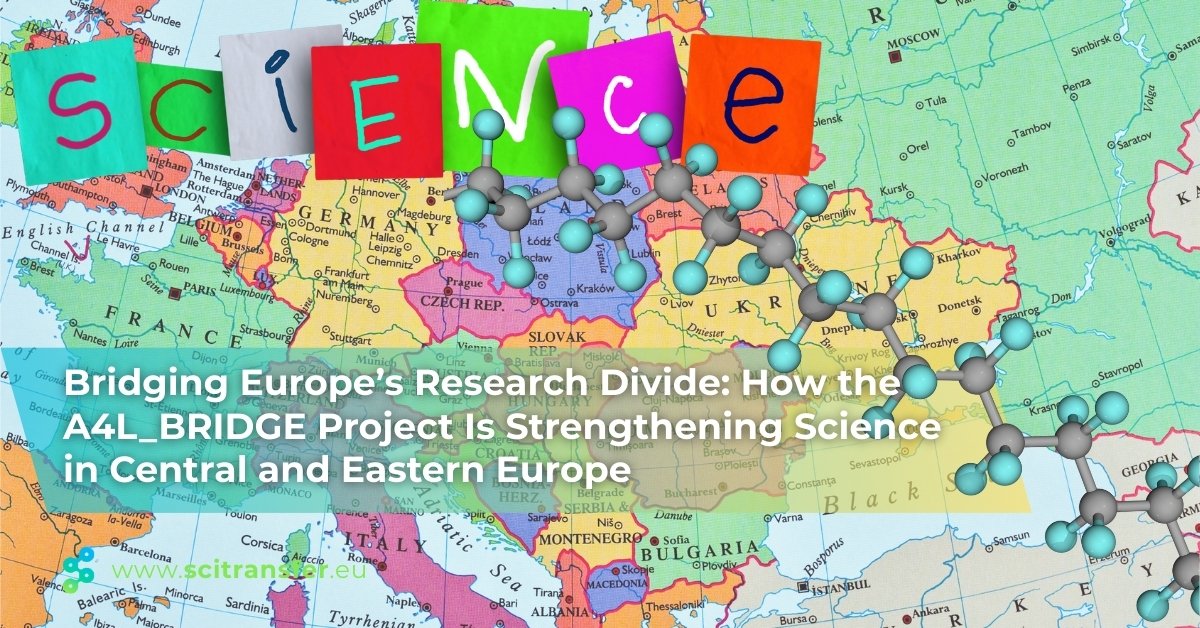
Europe is one of the world’s leading scientific regions. Yet behind its strong research performance lies a persistent imbalance. While many Western European institutions dominate global rankings, numerous research centres in Central and Eastern Europe continue to face more challenging structural conditions.
The gap is not simply about funding. It reflects deeper differences in governance, research culture, career opportunities, and the maturity of surrounding innovation ecosystems. Addressing these disparities has therefore become a strategic priority for the European Union.
The Horizon Europe project A4L_BRIDGE aims to tackle this challenge directly. Supported by €4.7 million in EU funding, the initiative focuses on strengthening research institutions in Central and Eastern Europe by improving governance, supporting talent development, and fostering cross-border collaboration. Rather than investing solely in equipment or individual research projects, A4L_BRIDGE targets the institutional systems that enable scientific excellence to develop and thrive over the long term.

Why the European Research Gap Persists
The research and innovation gap between Western Europe and many countries in Central and Eastern Europe remains one of the EU’s most significant scientific challenges. Institutions in the region often operate within less developed innovation ecosystems, where collaboration between academia and industry can be fragmented and career paths for researchers less attractive.
These conditions create a difficult cycle. Even when strong research teams emerge, institutions may struggle to retain talented scientists or establish long-term research programmes. Without modern governance structures and competitive career frameworks, promising researchers sometimes move to environments where opportunities and resources are more stable.
A4L_BRIDGE is built on a key insight: scientific excellence does not emerge from laboratories alone. It also depends on the institutional environment—how organisations manage talent, coordinate collaboration, and support innovation.

The Alliance4Life Network
A4L_BRIDGE builds on the Alliance4Life network, a collaboration established in 2018 that connects 12 health research institutions and universities across 11 countries in Central and Eastern Europe.
Over the past several years, the alliance has developed into an active community dedicated to strengthening research governance and improving institutional performance. Member institutions exchange experience, share best practices, and test reforms designed to increase research competitiveness.
A4L_BRIDGE extends this work by implementing reforms that have already been successfully piloted within the network. Rather than launching isolated initiatives, the project focuses on embedding effective practices into everyday institutional operations.
The initiative is coordinated from the Czech Republic and relies strongly on peer learning among institutions that share similar structural challenges but bring diverse practical experience.

Strengthening the Institutions Behind Scientific Excellence
At the heart of A4L_BRIDGE lies the recognition that institutional governance strongly influences research quality. Leadership structures, career development systems, and collaboration mechanisms all affect an organisation’s ability to attract talent and produce high-impact science.
The project therefore focuses on several strategic areas.
Improving Institutional Competitiveness
One major objective is strengthening governance within participating institutions. By exchanging best practices and implementing organisational reforms, the alliance works to improve leadership structures, transparency, and long-term strategic planning.
These changes can significantly increase the attractiveness of research institutions, helping them retain talented researchers and build stable, high-performing research environments.
Developing Talent Across Career Stages
Another central focus of the project is the development of research talent. A4L_BRIDGE is establishing a comprehensive educational framework that includes mentoring programmes, e-learning opportunities, and international internships.
These initiatives support researchers at different career stages while also strengthening the capabilities of research managers, administrators, and technology transfer professionals. Modern research institutions depend on this broader ecosystem of expertise to transform scientific ideas into impactful innovations.
Strengthening Industry Collaboration
A4L_BRIDGE also works to enhance collaboration between research institutions and industry. To support this goal, the project is establishing an Industry Relationship Platform designed to promote knowledge transfer and encourage participation in applied research initiatives.
Stronger links between academia and industry can accelerate the translation of scientific discoveries into practical solutions—particularly in areas related to health research.

The Virtual Research Centre
One of the most visible components of the project is the creation of a Virtual Research Centre. Instead of building a single physical institute, the initiative connects research groups across the region through a shared collaborative infrastructure.
This virtual environment allows scientists from different institutions and countries to exchange expertise, initiate joint projects, and coordinate research activities more efficiently.
The project also provides seed funding for early-stage collaborative studies, enabling researchers from multiple Alliance4Life institutions to develop new partnerships and prepare future Horizon Europe proposals.
By connecting researchers across Central and Eastern Europe, the Virtual Research Centre helps transform dispersed expertise into coordinated research initiatives with stronger international visibility.
Aligning Science with Policy and Society
Research institutions do not operate in isolation. Their success depends on the broader policy environment and on how scientific work interacts with society.
A4L_BRIDGE therefore actively engages policymakers and national stakeholders across the region. Through conferences, workshops, webinars, and dissemination activities, the alliance promotes the principles of the European Research Area—which aims to strengthen collaboration, openness, and excellence in European science.
The project also involves societal stakeholders in discussions about research priorities. End users of health research outcomes—including healthcare professionals and community representatives—are invited to contribute to shaping research agendas.
Such engagement helps ensure that scientific research addresses real societal needs while strengthening trust between research institutions and the public.
Building Stronger Foundations for European Science
Institutional reforms may appear distant from the everyday work of laboratories, yet they play a crucial role in shaping scientific success. Organisations that provide supportive leadership, transparent governance, and clear career opportunities are better positioned to retain talent and sustain ambitious research programmes.
By strengthening these foundations, A4L_BRIDGE aims to transform promising research centres in Central and Eastern Europe into durable pillars of European scientific excellence.
In doing so, the project contributes to a more balanced European research ecosystem—one in which talent can thrive across the continent and where collaboration between institutions becomes a key driver of innovation.
Autor: Radoslav Todorov
Images: canva.com, scitransfer.eu, European Commission
Sources