
In the effort to meet Europe’s climate targets, the maritime sector remains one of the most complex areas to decarbonise. Ships are essential to trade and mobility, yet they are also a significant source of greenhouse gas emissions. Within this context, the ZEAS project (Zero Emission Adriatic Ship) provides a concrete example of how scientific innovation, industrial collaboration, and public investment can be combined to deliver practical solutions.
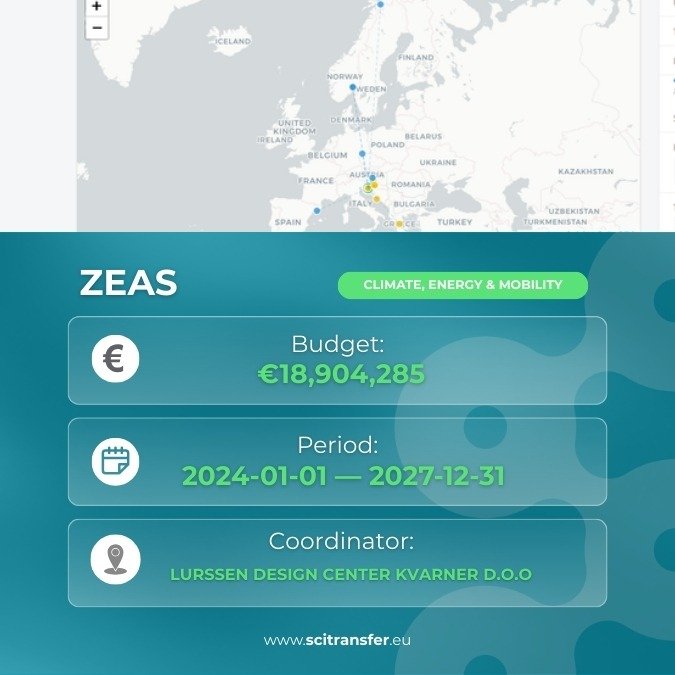
Funded under the Horizon Europe programme, ZEAS goes beyond conventional research. It is an operational-scale demonstration project aimed at bringing a new generation of hydrogen-powered passenger vessels into real-world use. With a total budget of €18.9 million, including €13.5 million in European Commission funding, the project represents a substantial investment in aligning maritime transport with the European Green Deal.
From Concept to Sea: Demonstrating Hydrogen at Scale
The core objective of ZEAS is to accelerate the adoption of climate-neutral fuels in waterborne transport. This is achieved through the development and demonstration of a zero-emission passenger vessel powered by hydrogen fuel cells under real operating conditions.
The vessel is being designed for the Adriatic Sea, a region of both economic importance and environmental sensitivity. Deploying the technology in such a context highlights the need to reduce emissions in areas where ecological impact is particularly critical.
The project includes extensive sea trials to validate performance, safety, and compliance with certification requirements. These trials are essential for regulatory approval and for building confidence among operators and public authorities. In parallel, ZEAS will carry out emissions assessments, environmental performance evaluations, and comprehensive safety analyses.
Building the Infrastructure for a Hydrogen Future
A zero-emission vessel requires supporting infrastructure. ZEAS addresses this by developing solutions for hydrogen distribution, storage, and bunkering—key elements for the practical use of hydrogen as a maritime fuel.
By linking vessel development with infrastructure, the project tackles one of the main barriers to adoption: the absence of integrated, end-to-end solutions. The focus is not only on technical feasibility, but also on operational viability within a broader transport system.
Digital Innovation Meets Maritime Engineering
ZEAS also integrates advanced digital technologies into vessel design and operation. A central component is the development of a digital twin—a virtual model enabling real-time monitoring, simulation, and performance optimisation.
The project further explores predictive maintenance systems supported by augmented reality. These tools aim to reduce downtime, improve safety, and optimise operational costs, with potential implications for how vessels are managed across the sector.
A Strong European Consortium
The project brings together 15 organisations, coordinated by Lürssen Design Center Kvarner d.o.o. in Rijeka, Croatia. The consortium includes maritime operators, research institutions, and industrial partners, combining expertise across multiple domains.
Participants include Jadrolinija, the Technical University of Chemnitz, HyCentA Research GmbH, TECO 2030, DNV, and the Croatian Hydrogen Association. This multidisciplinary collaboration reflects the complexity of the challenges addressed and the need for coordinated action at European level.

From Demonstration to Deployment
ZEAS is designed with a clear pathway towards commercialisation. Running from January 2024 to December 2027, the project includes the development of feasibility studies and business plans to support wider deployment.
This focus on market readiness distinguishes it from more traditional research initiatives. The objective is not only to generate knowledge, but to enable the uptake of validated solutions in real operational contexts.
If successful, ZEAS could support the broader adoption of hydrogen and other climate-neutral fuels in European maritime transport, contributing to both emission reductions and sector competitiveness.
Delivering Value to Society
The benefits of ZEAS extend beyond the maritime industry. Reduced emissions in coastal regions can improve air quality and public health, while lower environmental impact supports the preservation of marine ecosystems that are vital for biodiversity, tourism, and local economies.
At the same time, the project contributes to Europe’s capacity in clean technologies by strengthening expertise and industrial capabilities in hydrogen-based solutions.
A Model for Future Innovation
ZEAS illustrates how European-funded projects can bridge the gap between research and implementation. By combining technological development with real-world testing and deployment planning, it demonstrates an integrated approach to innovation.
As Europe advances towards climate neutrality, initiatives such as ZEAS highlight the importance of investing in solutions that are not only technically viable, but also operationally and economically feasible. In this sense, the project represents a meaningful step towards the decarbonisation of maritime transport.
Autor: Radoslav Todorov
Images: canva.com, scitransfer.eu
Sources:
- https://projectzeas.eu/
- https://trimis.ec.europa.eu/project/ferry-demonstrator-switch-safe-use-sustainable-climate-neutral-fuels-adriatic-zero-emission
- https://cordis.europa.eu/project/id/101138530
- https://map.scitransfer.eu/project/zeas-101138530