
Across Europe, healthcare systems face a striking paradox. Biomedical research generates unprecedented volumes of data, yet much of this knowledge remains difficult to translate into routine clinical practice. Research infrastructures collect valuable information on diseases, treatments and environmental exposures, but legal constraints, technical barriers and differences between national systems often prevent these resources from being fully used.
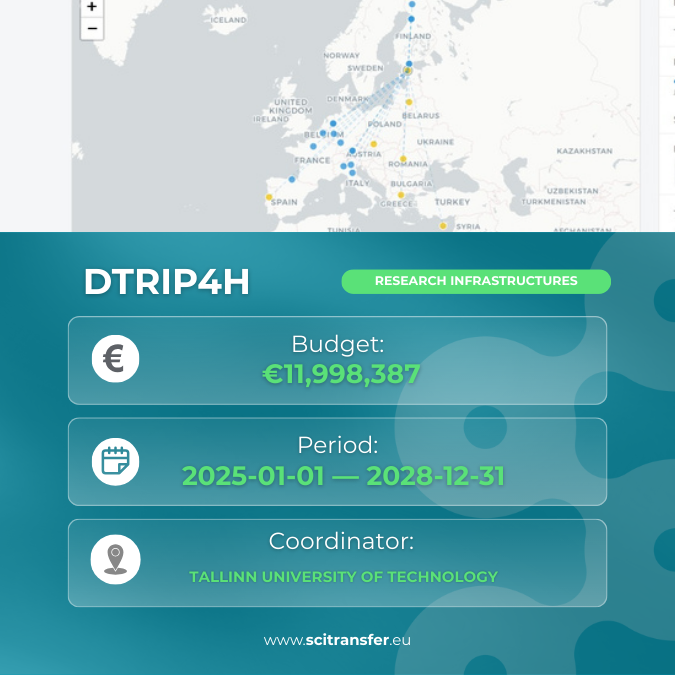
The Horizon Europe project DTRIP4H – Enabling Decentralised Digital Twin Era in Existing Research Infrastructures for Predictive, Preventive, Personalised and Participatory Health seeks to address this challenge. With €11,998,387 in EU funding, the initiative is building a technological ecosystem intended to support a new generation of biomedical research and healthcare decision-making.
At the centre of the project is the concept of digital twins—computational models that simulate biological systems or individual patients. Such models allow researchers to explore disease mechanisms, anticipate health risks and evaluate treatment strategies while keeping sensitive patient data securely within the institutions where they originate.
Europe’s Health Data Challenge
Over the past two decades, Europe has invested significantly in research infrastructures that support biomedical science. These infrastructures include advanced laboratories, data platforms and collaborative networks designed to accelerate discoveries in medicine and the life sciences.
However, their potential is often limited by fragmentation. Valuable datasets are distributed across institutions operating under different regulatory frameworks, governance models and technical standards. As a result, researchers frequently face difficulties when attempting to combine data across borders or build large-scale predictive models.
This fragmentation can slow the translation of research results into practical tools that benefit clinicians, patients and healthcare systems.
The DTRIP4H project addresses this issue by developing a decentralised digital twin ecosystem connected to existing European research infrastructures. Instead of creating a centralized platform, the project investigates how distributed infrastructures can collaborate securely while respecting legal and ethical requirements, including full compliance with the EU’s General Data Protection Regulation (GDPR).
Digital Twins and Predictive Medicine
Digital twin technology has already transformed sectors such as engineering and manufacturing. In healthcare, it is emerging as a promising tool for understanding complex biological systems.
A health digital twin is a computational representation of biological processes or individual patients built from biomedical data using advanced modelling techniques. These models allow researchers to simulate disease progression, analyse biological interactions and explore how different treatments may influence outcomes.

Rather than relying solely on historical data or clinical trials, scientists can use digital twins to conduct simulations in virtual environments. In these environments, researchers can evaluate treatment strategies, test hypotheses and explore disease trajectories before interventions are applied in real-world settings.
Such capabilities could support a shift from reactive healthcare—treating illness once it appears—toward a more predictive and preventive model of medicine, where risks are identified earlier and interventions can be tailored to individual patients.
Technologies Behind the Ecosystem
To enable digital twins in a distributed research environment, the DTRIP4H ecosystem combines several advanced technologies.
One key component is federated learning, a machine-learning approach that allows artificial intelligence models to be trained across multiple institutions without transferring raw patient data. Instead of moving datasets to a central location, algorithms are sent to where the data are stored. They learn locally and share aggregated insights rather than sensitive information.
The project also explores generative artificial intelligence to create synthetic datasets. These datasets reproduce statistical patterns found in real biomedical data but do not correspond to identifiable individuals. Synthetic data can therefore be used to test algorithms and run simulations while reducing privacy risks.

In addition, virtual and augmented reality tools are being investigated to visualise complex biomedical simulations and support interactive analysis of health data.
Together, these technologies enable researchers to analyse distributed biomedical datasets while maintaining strong privacy protections.
Seven Health Applications
DTRIP4H focuses not only on technological development but also on demonstrating practical applications. The consortium is developing seven proof-of-concept use cases that apply digital twin approaches to specific health challenges.
These use cases span several areas of biomedical research.
One focuses on cancer research, exploring how digital twins can simulate disease progression and treatment responses. Another examines drug development, where computational models may help predict the effects of new compounds before they enter clinical trials.
The project also investigates environmental exposome research, analysing how environmental exposures influence health over time.
Additional applications explore precision treatment strategies for schizophrenia and AI-driven personalised medicine, integrating multiple biomedical data sources to support tailored therapeutic approaches.
These use cases serve as testing environments for the broader digital twin ecosystem and illustrate how decentralised infrastructures can support complex biomedical simulations. The results may benefit not only academic researchers but also companies, innovators and industrial partners developing digital health technologies.
Protecting Privacy in Health Research
The growing use of health data raises important questions about privacy and ethics. DTRIP4H addresses these concerns through a combination of technological safeguards and regulatory compliance.
Federated learning ensures that sensitive patient data remain within the institutions where they were originally collected. Instead of transferring datasets across borders, algorithms analyse information locally and share insights without exposing identifiable records.
At the same time, synthetic datasets generated through artificial intelligence provide additional opportunities for experimentation and method development.
By integrating these approaches, the project aims to create a research environment where scientific collaboration and privacy protection coexist, enabling large-scale data analysis while respecting strict regulatory requirements.
Toward the Future of Digital Health
As healthcare becomes increasingly data-driven, secure and interoperable research infrastructures will play a crucial role in enabling scientific progress.
Rather than replacing Europe’s diverse healthcare systems with a single centralised platform, DTRIP4H proposes a model that connects distributed infrastructures while respecting institutional autonomy and regulatory frameworks.
If successful, the project could accelerate biomedical research, support the development of new medical technologies and improve predictive tools for clinicians.
With nearly €12 million in Horizon Europe funding and a growing network of research partners, DTRIP4H represents an important step toward the future of digital health in Europe—a future in which advanced data analysis and collaborative infrastructures help transform healthcare into a system that is predictive, preventive, personalised and participatory.
Autor: Radoslav Todorov
Images: canva.com, dtrip4h.eu, scitransfer.eu
Sources: