
In recent years, genomics and proteomics have moved far beyond specialised laboratory disciplines. They have become essential components of modern medical infrastructure—from the precise diagnosis of rare diseases to targeted cancer therapies and the management of public health crises.
Yet access to these capabilities is not evenly distributed across Europe. Differences in infrastructure, expertise and institutional capacity mean that some research ecosystems are able to fully benefit from genomic technologies, while others are still developing the necessary foundations.
The FORGENOM II project addresses this challenge by strengthening genomics, proteomics and bioinformatics capacity at Comenius University in Bratislava, helping to position Slovakia more firmly within the European research and innovation landscape.
Map SciTransfer EU (https://map.scitransfer.eu/project/forgenom-ii-101160008)
Genomics as a Public Resource
The FORGENOM II project (Fostering Excellence in Advanced Genomics and Proteomics Research at Comenius University in Bratislava) is aimed at strengthening genomics, proteomics and bioinformatics at Comenius University in Bratislava. At its core lies a simple but strategic idea: modern biomedical tools have a real impact only when they are supported by a stable institutional environment.
Genomics and bioinformatics have already demonstrated their importance both in personalised medicine – through the development of more precise medicines and therapies for serious diseases such as cancer and rare conditions – and in the response to the COVID-19 pandemic, where the analysis of genomic data played a key role. The question is not whether these technologies work, but whether all research ecosystems in Europe can use them on equal terms.

From “Lagging” Capacity to European Visibility
In Slovakia, genomics and bioinformatics have been developing rapidly, including thanks to the efforts of Comenius University. Nevertheless, the university’s capacity and expertise still lag behind those of leading European centres. FORGENOM II seeks precisely to bridge this gap.
The project uses the “twinning” model – targeted partnerships with leading institutions – to accelerate access to scientific excellence. The Slovak team’s partners are European Molecular Biology Laboratory (EMBL) in Germany and Università degli Studi di Milano-Bicocca in Italy.
This partnership is not symbolic. It includes mentoring, training, the exchange of best practices and the targeted development of a research profile. The aim is for Comenius University to become a recognisable European centre in biomedical genomics and proteomics, with increased participation in European and international projects.
A Project That Invests in the System, Not in a Single Experiment
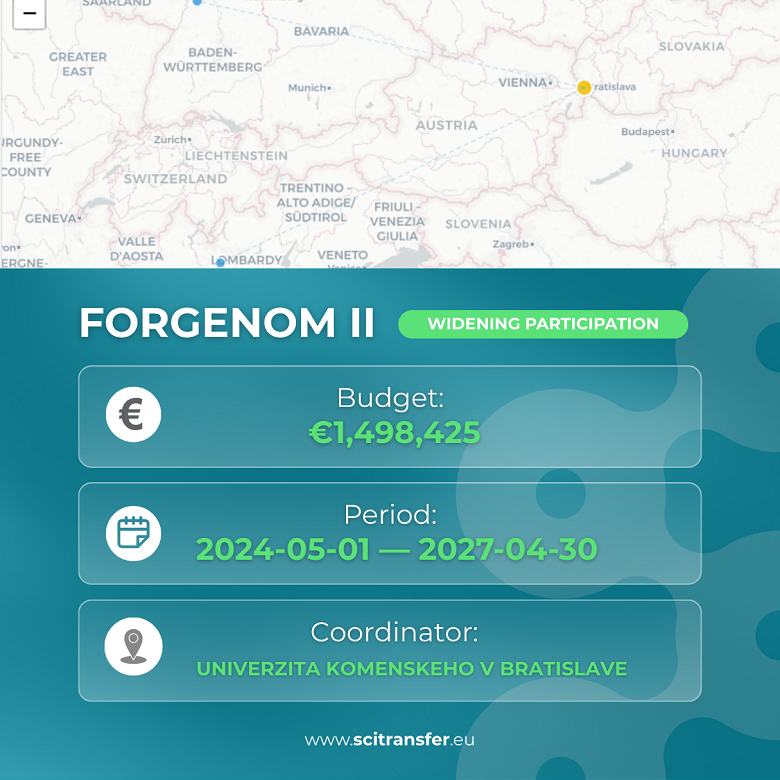
FORGENOM II is funded under the HORIZON-CSA scheme (Coordination and Support Action), which means that the resources are not allocated to specific laboratory experiments, but to coordination, networking, training and institutional development. The total budget amounts to €1,498,425, provided as a contribution from the European Commission. The duration runs from 1 May 2024 to 30 April 2027.
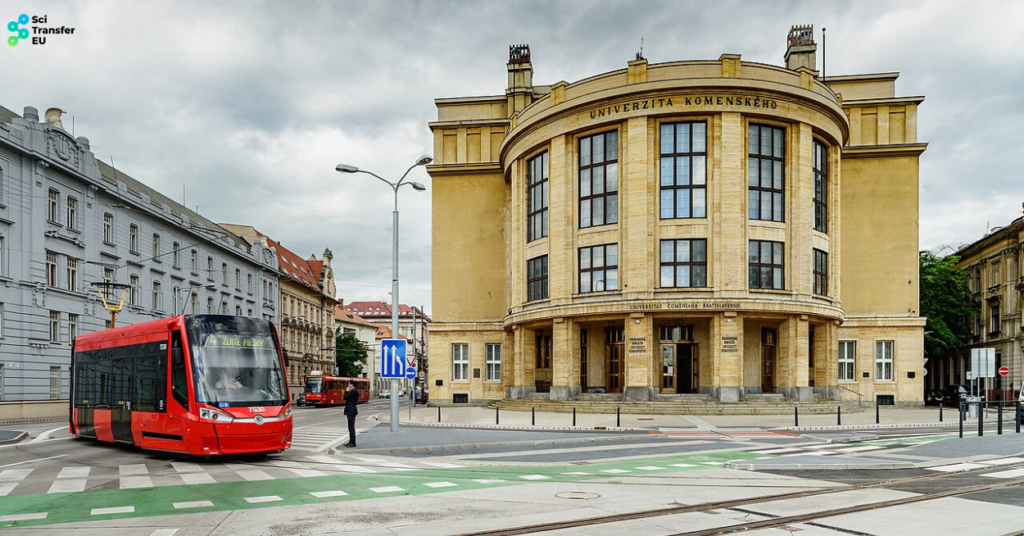
The coordinator is UNIVERZITA KOMENSKEHO V BRATISLAVE (UK BA), and the project is part of the EU’s “Widening Participation” efforts – a policy designed to strengthen research and innovation performance in underrepresented regions. The project brings together two additional partners: European Molecular Biology Laboratory (EMBL), based in Heidelberg, Germany, and Università degli Studi di Milano-Bicocca (UNIMIB), based in Milan, Italy.
This logic is strategic: without a critical mass of skills, infrastructure and international connections, even the most advanced technology remains of limited impact. For this reason, FORGENOM II treats institutional development not as an administrative add-on, but as a scientific accelerator.
What Does This Mean for Society?
The benefits are not abstract. Stronger genomic and proteomic capacity means:
- faster and more precise diagnostics;
- better targeting of therapies;
- improved preparedness in the face of infectious crises;
- greater integration of the national health system into European networks.
In addition, the project can increase Slovakia’s attractiveness to young scientists. The quality of mentoring, the reliability of infrastructure and international connections are often decisive factors in choosing an academic career. If FORGENOM II achieves its objectives, the country will have not only stronger laboratories, but also a more competitive research environment.
Science as a Long-Term Investment
Within the framework of European research policy, FORGENOM II occupies a specific position. It does not promise immediate medical breakthroughs. Instead, it builds the conditions under which such breakthroughs become possible.
Through targeted training, networking and the transfer of know-how from institutions such as EMBL and Università degli Studi di Milano-Bicocca, Comenius University gains access to the best practices in Europe. This gradually raises the scientific level, the quality of research, the university’s international visibility and competitiveness – and, more broadly, that of the Slovak research and innovation system.
In a world in which medicine is becoming increasingly dependent on data, algorithms and molecular profiles, genomic capacity is a strategic resource. FORGENOM II demonstrates that building this resource requires not only technologies, but also institutional architecture.
This is the project’s true value: it transforms genomics from a specialised scientific field into a public asset – one that serves patients, the scientific community and the future development of European medicine at the same time.
Autor: Radoslav Todorov
Sources
- Official project website: https://www.forgenom.com/
- Project events page: https://www.forgenom.com/events-1
- CORDIS project page (Project ID: 101160008): https://cordis.europa.eu/project/id/101160008